
Applying Evidence-Based Design to Drive Continuous Improvement in Healthcare Spaces
Evidence-based design (EBD) is an approach that grounds decisions about the built environment in credible research and measurable outcomes. In healthcare, where patient experience, clinical performance, and staff well-being intersect, this disciplined process helps ensure that design choices improve how care is delivered.
At BHDP, our research framework is fully integrated into our design process, closely mirroring the EBD methodology. This alignment enables us to apply evidence-based design across projects without departing from our proven approach to design delivery. In this post, we explore how EBD principles are woven into our process and share the results of a recent project that leveraged our evidence-based design approach from early inquiry through post-occupancy evaluation.
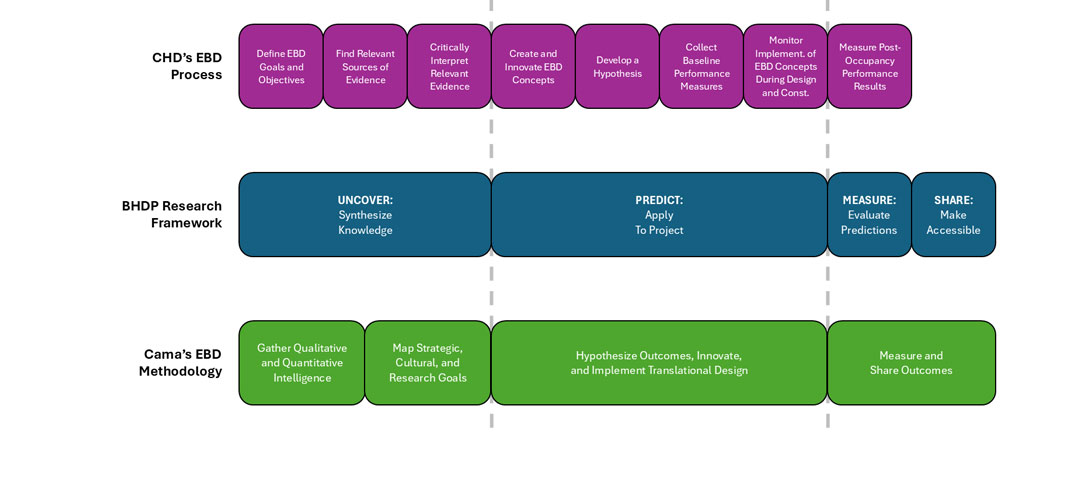
Figure 1
How We Integrate Evidence-Based Design
Our approach is informed by two widely cited models in healthcare-focused evidence-based design:
- The Center for Health Design’s (CHD) eight-step EBD process, which emphasizes defining goals, locating and appraising evidence, creating and testing design concepts, collecting baseline performance measures, and conducting post-occupancy evaluations.
- Rosalyn Cama’s four-step EBD methodology, which integrates qualitative and quantitative intelligence, maps strategic and cultural goals, establishes design hypotheses, and concludes with measuring and sharing outcomes.
Both frameworks share a common structure of rigorous inquiry, the translation of insights into intentional design decisions, and the subsequent evaluation of results to advance knowledge. In practice, these models reinforce the logic built into BHDP’s research framework. Figure 1 aligns evidence-based design across CHD’s process, Cama’s methodology, and our own Research Framework to illustrate how they complement and reinforce each other. This alignment underscores a shared commitment to basing decisions on credible information, applying insights through translational design, and generating findings that contribute to ongoing improvement.
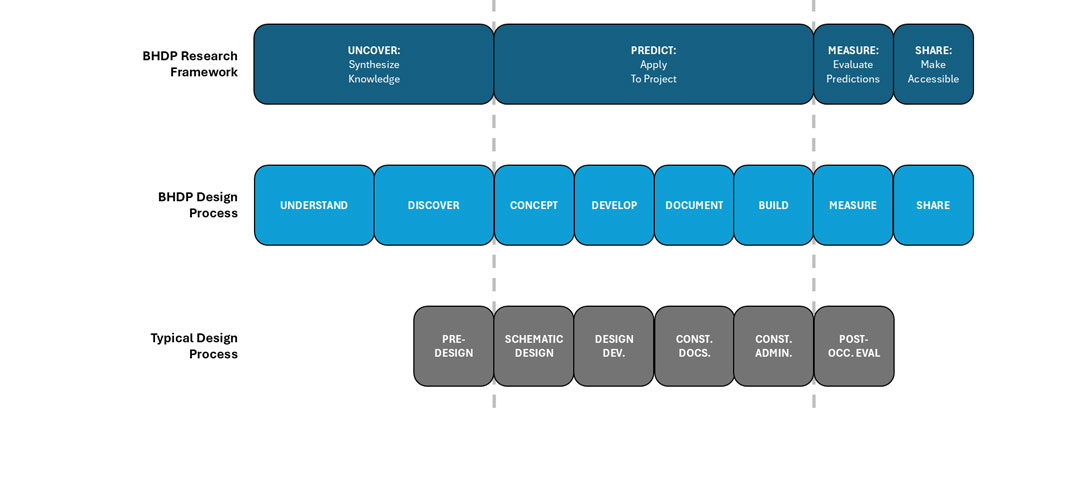
Figure 2
In Figure 2, we illustrate the integration of research across our comprehensive design process, demonstrating how empirical inquiry is embedded at each phase to support an evidence-based design approach. In BHDP’s research framework, the Uncover phase forms the foundation for integration. Here, we identify goals, gather qualitative and quantitative intelligence, review available evidence, and establish success criteria with clients and users. This early emphasis ensures that the needs of patients, families, and staff are understood clearly and supported by research rather than by designers’ biases or assumptions. By collecting existing baseline performance measures at this stage, we establish the benchmarks necessary for a meaningful post-occupancy comparison.
In the Predict phase, insights from Uncover help to develop hypotheses, or what we call “predictions,” that inform specific design strategies based on desired outcomes. These predictions guide our Concept and Develop work and provide a structured way to test the logic of design decisions at the project’s end. Embedding predictions directly into the design ensures that built environments can be rigorously evaluated rather than assessed solely on perception.
The Measure and Share phases complete the cycle. Post-occupancy evaluations enable us to assess whether design interventions have delivered the intended results and compare them with the baseline measures. Dissemination ensures lessons learned strengthen future projects. This cyclical, evidence-focused approach builds a cumulative body of knowledge that benefits clients, project teams, and the broader healthcare design community.
Why Evidence-Based Design Matters in Healthcare
A growing body of research demonstrates that environmental factors have a significant impact on patient, family, and staff outcomes. Access to daylight, views to nature, and acoustics have been shown to reduce stress, improve recovery, and increase satisfaction. For staff, evidence-based interventions that support visibility, respite, and recharge, as well as intuitive navigation, contribute to lower fatigue and higher job satisfaction. These outcomes, along with the underlying research, demonstrate why healthcare environments benefit from a research-driven design approach that continually measures and improves performance.
A Recent Application: Redesigning an Inpatient Pharmacy
Our redesign of a hospital system’s inpatient pharmacy demonstrates how evidence-based design operates across a project’s life cycle. During the Uncover phase, our team conducted interviews, workflow observations, and benchmarking to identify operational inefficiencies and understand staff needs. Employees also participated in a pre-measure survey to establish baseline perceptions and metrics of the existing environment. These activities provided a structured understanding of pain points and opportunities for improvement.
In the Predict phase, we developed hypotheses that shaped the design direction. In this example, we predicted that consolidating and optimizing automation would help address staffing pressures while improving accuracy and throughput. In addition, we repositioned the clean room and anteroom as a central spine rather than placing them at the front, predicting that this new configuration would shorten staff travel distances, increase visibility, and create clearer separation between work types. These design predictions established a transparent link between design interventions and expected outcomes.
Following occupancy, we assessed performance using structured surveys with the same questions as those used for the existing baseline condition. This allowed for a comparison of pre-design and post-design perceptions of pharmacy staff across various factors, including collaboration, efficiency, flexibility, and the effectiveness of specific spaces. Figure 3 illustrates some of the resulting deltas between pre- and post-occupancy, showing improvements in post-occupancy ratings across all of these measured categories. The results validated the design approach and provided insights to inform future projects.
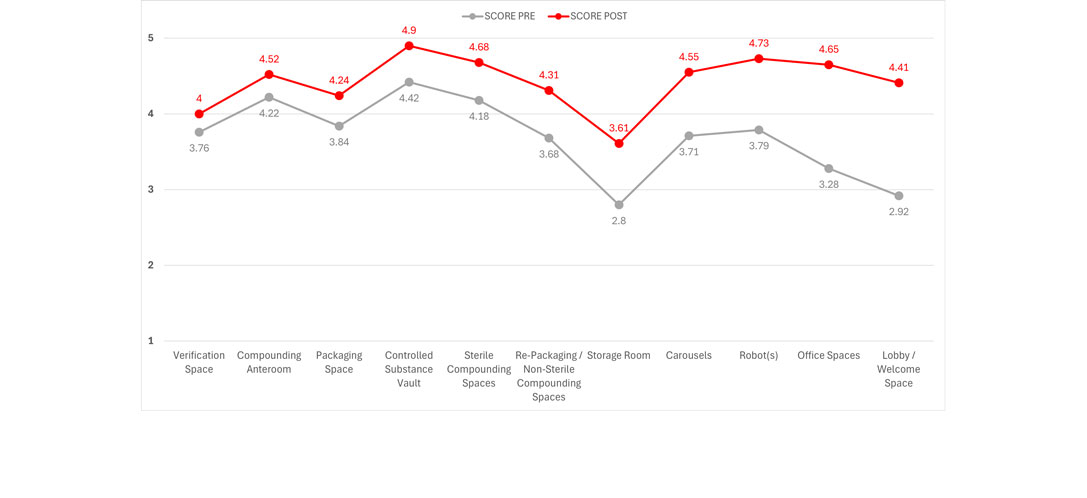
Figure 3
Advancing Healthcare Through Continuous Learning
Evidence-based design is not a single project methodology but a continuous learning system. By grounding decisions in evidence, testing hypotheses through built work, and measuring performance outcomes, healthcare organizations can make strategic investments that evolve with clinical practice, new technologies, and shifting patient expectations.
At BHDP, the findings generated through our integrated research framework and design process inform future healthcare projects and enrich our work in other markets, including workplace, higher education, and laboratory settings, where insights from these sectors, in turn, enhance our healthcare projects. This cross-market perspective enhances our ability to design environments that effectively support people and respond to changing operational demands.
Healthcare environments perform best when they are both responsive and forward-looking. Evidence-based design offers a structured, research-driven approach for achieving this balance and creating spaces that deliver measurable improvements for patients, their families, and caregivers.
Interested in partnering with a team that actively applies evidence-based design to create healthcare environments that deliver measurable results? Use the form below to get started.
Author
Content Type
Date
January 23, 2026
Market
Practice
Topic
Healthcare Design


Dr. Justin Ferguson, Director of Applied Research
With three decades of researching, teaching, and practicing community-engaged and organizational design and planning, Dr. Justin Ferguson brings both immense knowledge and enthusiasm to creating strategic and transformative environments. As Director of Applied Research, Justin seeks to uncover the challenges clients face with their organizational spaces, works with design teams to develop predictive design decision-making, and ultimately measures the efficacy of BHDP’s work. His extensive portfolio spans various markets across the U.S., including collaborations with major clients like the GSA and Fifth Third Bank, making him a unique asset to BHDP.

David Johnson, President and Chief Operating Officer, Partner
David Johnson joined BHDP in 2017 as the Chief Operating Officer. He is a licensed architect with experience in designing and managing projects and teams in multiple markets, including over a decade of building expertise in public safety design. Prior to serving as President, he led BHDP's Workplace market and oversaw a variety of projects for some of BHDP’s largest clients. David is inspired by curiosity and the success of people and processes while specializing in relationship-based project management. He is driven by the desire for excellence for both the internal team and for his clients.