
Brackets, Buildings, and Branding: The Slam-Dunk Case for Including Athletics Facilities in Your Master Plan
This month, institutional leaders across the U.S. with recruiting goals on their minds watched the NCAA Division I Men’s Basketball Tournament “Selection Sunday” drama unfold, reminding them of a time-honored truth: regardless of the season, collegiate athletics is one of the few aspects of higher education that offers institutions a lay-up in capturing broad public attention. But the real work of athletics—recruiting, fanbase and community building, merchandise sales and revenue generation, and the student experience—happens far from the TV cameras.
Rather, this “behind the scenes” work happens in the physical environment of a campus, in spaces like the:
- practice gyms,
- weight rooms and athletic training centers,
- academic support offices,
- sports medicine suites,
- residence halls, and the connective tissue of campus that gets students, families, and visitors to these places.
The challenge, however, for higher education leadership is that athletics facilities are never just athletics facilities. They are donor magnets and, sometimes, political flashpoints. They can simultaneously drive engagement while raising questions about priorities. They can serve as a Final Four moment for an institution’s brand—or manifest as a costly turnover that crowds out other crucial academic and student-life investments.
In contrast to your favorite uncle’s “Whose Mascot is Faster”-themed March Madness bracket, let’s examine how campus leaders can treat athletics capital spending like a disciplined bracket and advance the right projects at the right time, with a strategy for winning.
First-Round Seeding: Balancing Athletics vs. the Rest of Campus
It’s not uncommon, though unfortunate, that master planning exercises skip the critical topic of prioritization. In doing so, many institutions with a newly minted master plan soon face questions of what gets funded first. From a master planning standpoint, the problem isn’t that athletics projects exist, but rather, when they arrive as a surprise “single-issue” initiative untethered from campus priorities.
For that reason, athletics improvements often land in direct competition with urgent needs such as deferred maintenance, classroom modernization, research capacity, residence life renewal, wellness support, and accessibility upgrades. This can feel like an either-or choice between student success and sports. That’s a false dichotomy. Yet it remains a powerful narrative if athletics spending is not appropriately positioned within a transparent, integrated master plan.
One way to reframe the conversation is to separate athletics facility investments into three baskets:
- Health, Safety, and Compliance: life safety improvements, accessibility, Title IX impacts, structural repairs, building envelope, mechanical infrastructure, etc.
- Performance and Recruitment: practice spaces, sports medicine, strength & conditioning, athlete development, diet & nutrition, recovery, etc.
- Experience and Brand: game-day environments, fan experience & concessions, “the student section,” broadcast and press areas, wayfinding and campus navigation, etc.
The Health, Safety, and Compliance basket should be approached with a seriousness befitting any modern institution, where safety and stewardship of resources are paramount. Conversely, the second and third baskets can be evaluated like other strategic investments from an ROI standpoint by quantifying their value proposition, recruitment potential, impact on the student experience, impact on campus navigation and connectivity, and total cost of ownership. In other words, don’t let athletics “go on a run” without playing the same disciplined game as the rest of campus capital projects in the master plan.
In the Double-Bonus: Athletics Facilities as a Front Door (and a Multiplier) for Recruitment
For many prospective students and families, the institution’s athletics environment is the most visible, emotionally resonant point of campus energy, regardless of whether the incoming student is an athlete. A modern stadium, a well-designed practice facility, or even an integrated athletics village can communicate momentum. Collectively, these facilities showcase institutional pride and legacy, and a sense that students belong to something bigger than themselves, before, during, and after their time on that campus.
Importantly, that does not mean every institution needs an expensive, new showcase building. It does, however, mean that institutional leadership needs to recognize athletics facilities function like a recruitment “multiplier.”
Specifically, this can play out in the way that athletics facilities don’t just house activities, but rather, they become part of a university’s visible identity. These facilities are frequently a key stop on the prospective student tour, as well as popular destinations for donor gatherings (to say nothing of their presence in the digital realm on social media). Their presence adds a significant chapter to the institution’s story as physical representations of tradition, resilience, aspiration, and institutional brand.
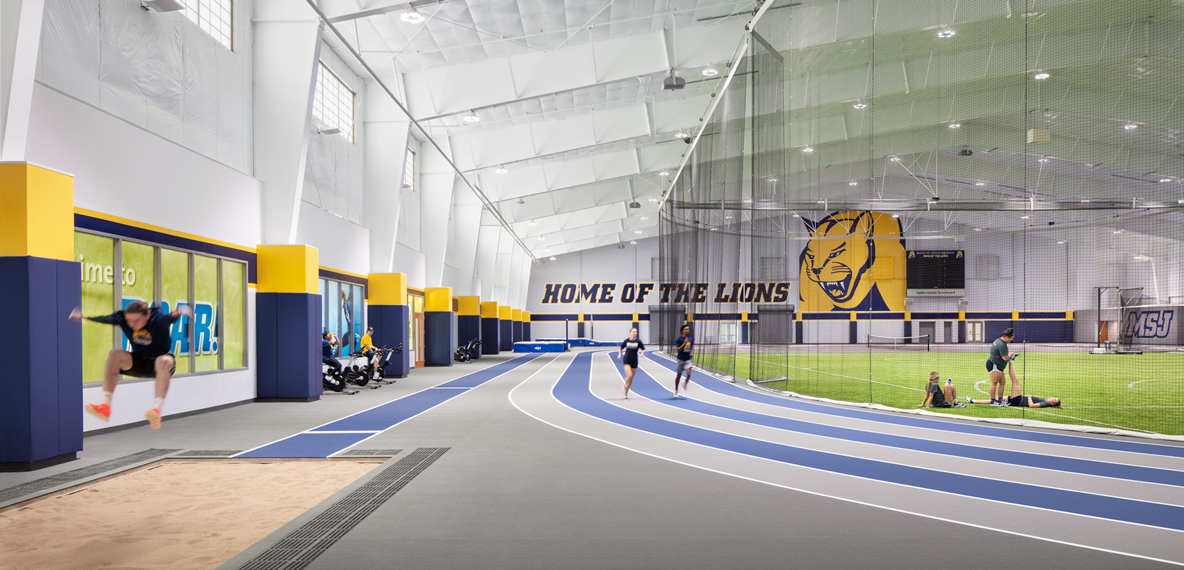
When planned well, flexible and adaptable athletics facilities can become the “utility infielder” of their respective campuses. Beyond the teams that call them home, they serve other groups such as club sports, intramurals, kinesiology programs, sports medicine training, student wellness, events, and even summer camps and local community partnerships. A single-purpose facility used only by a small percentage of the campus population is difficult to defend in a time of constrained budgets. A facility that expands access and shared use, perhaps even beyond the campus border, becomes a much more valued campus asset.
As the enrollment cliff threatens institutions with a reduced pool of potential students, leaders must recognize that recruiting is not limited to student-athletes. Therefore, an energized campus culture, anchored by well-planned “places to be” facilities (including those with a primary athletic purpose), helps recruit not only students, but also faculty and staff. It also strengthens alumni affinity, which certainly impacts campus fundraising far beyond athletics.
Once again, when master planning, institutions don’t need to view athletics and academics as an either-or scenario. to recognize the physical environment of athletics can simultaneously support enrollment stability and institutional growth, especially when investments in these space are aligned with broader campus initiatives, space utilization, the institutional story, and student recruitment.
Three-Pointer at the Buzzer: Your Athletic Facilities Can Be a Culture Engine!
The student experience is shaped by a thousand small moments along their journey. Belonging, pride, wellness, relationships, and tradition all factor in a student’s lasting impression of an institution. Athletics facilities contribute to that experience ecosystem in outsized ways, particularly for college basketball, where arenas become weekly gathering points that can blanket commuter students, resident students, faculty, alumni, and the surrounding community with a shared identity for a few hours.
In master planning terms, this is where the “March Madness” metaphor is particularly apt: the tournament isn’t only about athletic performance. Beyond the dribbling, passing, and foul shots on the court, the NCAA tournament is about emotion, grit, tradition, stories of teams and players, and a deeply invested community behind every one of them. Athletic facilities are the stage where those stories come to life.
Underscoring the point that these facilities can become part of the very cultural fiber of an institution, former Duke University basketball legend Grant Hill wrote in his book Game: An Autobiography (2022), “Cameron Indoor Stadium is a special place in sports and there's really nothing else out there quite like it. Anytime I'm inside Cameron, I've got memories. Cameron is like Yankee Stadium or the old Boston Garden."
With that in mind, even modest improvements in these spaces can dramatically strengthen the student experience and reinforce an institution’s culture and brand:
- Arrival and campus connectivity: Provide safe, intuitive pedestrian routes, clear and cohesive wayfinding, well-lit pathways and parking areas. Create a plan for game day surges that doesn’t punish everyday campus movement (remember, not every student is “going to the game!”).
- “Student-First” Game Day: Student entries, student seating, acoustics (in indoor environments), concessions, and orderly post-game flow make students feel welcome and prioritized.
- Non-Game Day utility: Study zones, small meeting rooms, academic support, wellness spaces, and flexible lobby/concourse areas keep the facility active outside of event days.
- Brand integration: Graphics, storytelling, and material choices tie athletics identity to institutional identity. The facility feels like a natural part of your institution, sharing your story and history through the lens of athletics.
When these elements are missing, arenas and similar venues often become “episodic” spaces. That is, while they are full during big games and events, the remainder of the time, they lie dormant and disconnected from the campus. Conversely, when these features are intentionally designed into a facility, it becomes a key campus asset that supports culture, recruitment, and community engagement.
Cutting Down the Nets: A Master Plan Lens for “Highest-and-Best Use”
Ultimately, institutional leaders need to look at their campus and ask, “How do we avoid getting into foul trouble when it comes to striking a balance between athletic facilities and other parts of our physical environment?” Before a single dollar is committed, consider the following questions that will prevent your athletics projects from becoming reactive:
- What is the role of athletics in your institution’s identity and growth strategy? How will these facilities—current or proposed—augment that growth strategy, and your brand?
- What goalposts are we aiming to move? For instance, recruitment numbers, retention rate, donor participation, student satisfaction, event revenue, or community partnerships.
- What is the “highest-and-best use” of our athletics footprint and precinct? Consider things like shared/multi-use, daily activation, and long-term adaptability.
- For each facility, what is the right project type to maximize the facility’s potential? These include renovation, addition, repurposing, deferred maintenance, and new construction.
- How does this project strengthen other campus priorities? Will it enhance mobility, improve the campus aesthetic, promote safety and wellness, and/or support academics?
Asking these kinds of questions at the outset can be the difference between a facility that wins the moment and one that wins the game… or the decade!
Don’t Build a Cinderella Story. Build a Program!
Every year, college basketball fans watch as March Madness rewards momentum, while simultaneously punishing teams that panic and abandon fundamentals. From that perspective, campus planning isn’t much different. Athletics facilities can be a catalyst for supporting recruitment, community, and brand in ways few other projects can. But if their path to victory doesn’t follow the same planning rigor as any critical institutional investment, they can quickly derail your game plan.
Higher education institutions that thrive are the ones that don’t chase every shiny facility trend. They build a coherent master plan and accompanying program aligning athletics, academics, student life, and campus operations into a whole that makes their college or university stronger—long after the final buzzer.
If you’re ready to integrate your campus athletics into your master plan, let’s talk—BHDP can help.
Content Type
Date
March 27, 2026
Market
Practice
Topic
Athletics