
From Blueprint to Belonging: Designing Campus Spaces that Embody Your Institution’s Culture
Most university campuses built over the last two or three decades feature a similar pattern: beautiful buildings, clean lines, and glass facades, fueling an odd sense that you could be anywhere.
Many colleges have been concerned about this universality in recent years. Put simply, they want spaces that carry their institution’s personality, not something that feels like a corporate office or a tech campus arbitrarily transplanted into higher education.
Why Identity Matters in Higher Education Design
This concern goes deeper than mere aesthetics alone. Students want to feel connected to the story and values of the place where they learn. This cultural intersection is where the built environment can incorporate the institution’s unique brand.
When design reflects campus character, students are far more likely to feel grounded, valued, and part of something bigger than themselves. That connection shapes behavior, identity, and, rather critically, the student's sense of belonging.
Colleges aren’t just asking for a new science building or a refreshed student center. They are asking for places that feel like their campus.
A Sense of Belonging on Campus
An educational space can nurture a sense of belonging by showing students they are connected to a story that existed before them and will continue long after they graduate.
Students notice when something feels out of place. A building that looks sleek on paper but doesn’t reflect the institution’s mission can unintentionally weaken brand cohesion. When architecture aligns with a college or university’s cultural values, the emotional bonds that keep students engaged are strengthened.
Colleges succeed when their environments reinforce their beliefs. Faith-based institutions, for example, often integrate subtle symbolism or quiet reflection spaces. Tech-focused universities lean into innovation cues that encourage creativity.
The Risk of “Beautiful but Generic” Buildings
A generic building is rarely intentional. It usually happens when design decisions prioritize function alone. The outcome can be a space that works well on paper but lacks the cultural identity students and faculty expect.
This is where university brand positioning becomes so important. Buildings communicate who you are before anyone reads a brochure or meets a professor, and if spaces look interchangeable with any institution, the brand weakens. Design should never dilute identity; it should reinforce it.
Space as Storyteller: Making Culture Visible
Place identity refers to the emotional and cognitive connections people form with physical spaces. When done well, it helps people feel like they belong. By the same token, it creates a subtle sense of disconnection when delivered poorly.
Architecture, interiors, materials, and graphics all tell the story of an institution. Through thoughtful design, a college can express values, celebrate milestones, and build pride. This is one way to create a sense of belonging, supporting both social cohesion and academic commitment.
Architecture That Embodies Mission, History, and Pride
An institution’s mission often provides guardrails for design. For older campuses, that might mean echoing historic materials or revisiting proportions found in legacy buildings. For younger institutions, it may involve bold contemporary spaces that symbolize progress and accessibility.
Either way, the building becomes an extension of the brand. Interior spaces can integrate graphics that highlight achievements, alumni contributions, or campus traditions. Material choices can align with brand colors and textures when executed properly. Even circulation paths can be shaped to encourage community and connection.
This is where physical design meets higher education branding to create environments that speak for the institution.
Practical Design Strategies to Reflect Culture
Culture is typically communicated as a concept. Making it tangible in an architectural and design context requires a strategic approach based on insights from key stakeholders. This strategy is best executed through:
- Experiential graphic design and branding
- Showcasing heritage and commemorating history
- Creating dedicated spaces for community, collaboration, and hands-on learning
Experiential Graphic Design and Branding
Experiential graphic design (EGD) combines storytelling and architecture. It’s a powerful tool for expressing university branding through everyday experiences. When students see visual cues that mirror institutional values, they internalize the message: “This is who we are.”
Galen College of Nursing: A Consistent Brand of Care
Galen College of Nursing needed a creative space with functional value and a compelling design. Across multiple campuses, the BHDP team used unified brand elements to communicate compassion and professionalism.
Graphic storytelling and visual narratives enhance and distinguish Galen’s branding in the world of nursing education. A consistent “Pure Nursing” philosophy is created through graphics, murals, and brand integration, instantly communicating the college’s identity. Motivational and encouraging phrases are placed outside learning and simulation labs, providing students with an inspirational and confidence-building learning environment.
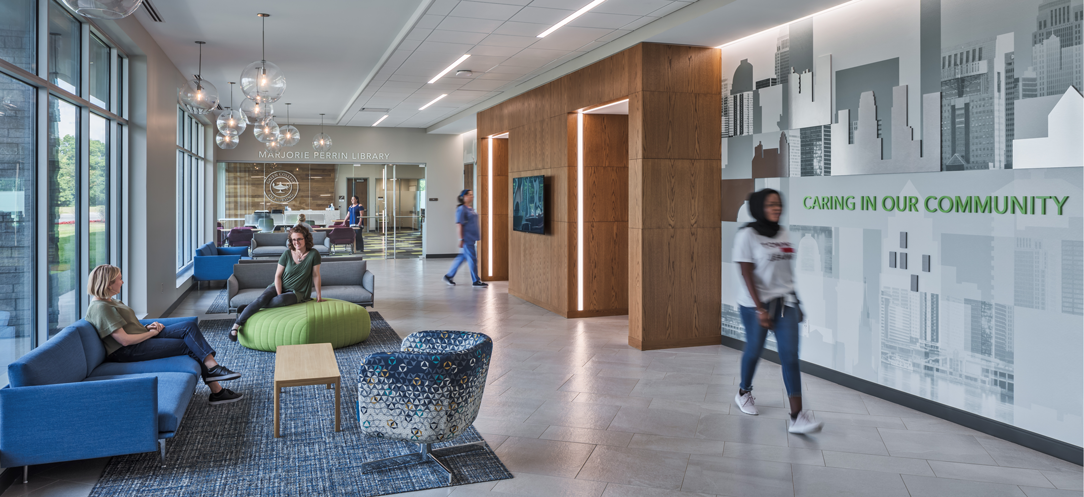
Galen College of Nursing’s Louisville campus features graphic storytelling that highlights its “Pure Nursing” philosophy and community-centric care.
Ohio Northern University: Communicating a Mission of Impact
Ohio Northern University sought an updated engineering building that would reinforce its hands-on ethos and foster high-impact educational experiences. In the James Lehr Kennedy Engineering Building, the BHDP team utilized color, typography, and spatial organization to embody those goals.
The EGD team helped enhance those goals further with:
- Inspirational quotes on colorful, value-reinforcing dimensional graphics
- A dynamic university timeline showcasing the engineering college’s rich history
- A three-story donor wall in the atrium, with acrylic backlit panels
A LEED feature wall showcasing wood sourced from trees removed during site clearing with the bold statement: “Progress is impossible without change.”
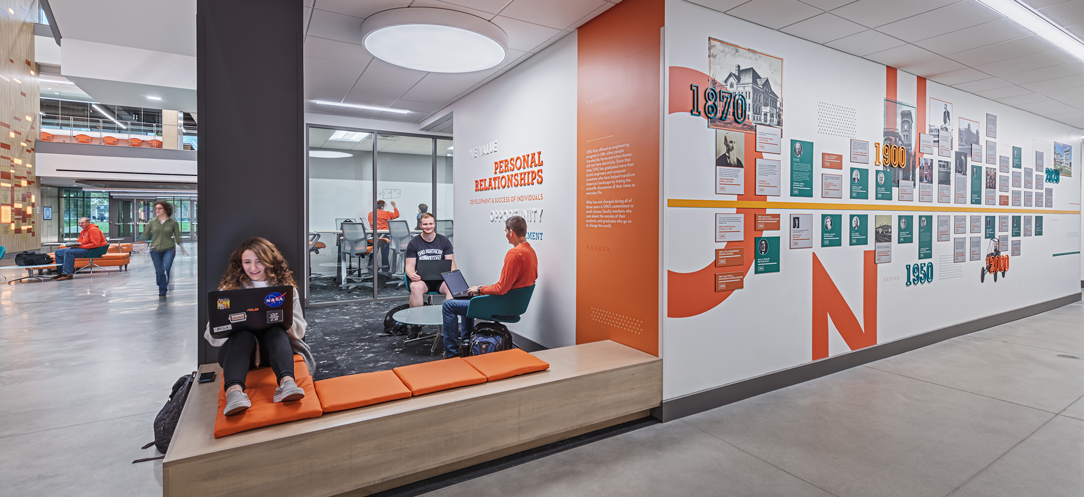
Bold treatments like this floor-to-ceiling history timeline make the Ohio Northern University James Lehr Kennedy Engineering Building vibrant and help foster high-impact educational experiences.
Showcasing Heritage and Tradition
Colleges with rich histories benefit from bringing the past into the present. Heritage walls, archival displays, and architectural references to heritage campus buildings help students feel part of a larger narrative.
Lycoming College: Telling the Story of a Music Legacy
Lycoming College’s Trachte Music Center has a rich and vibrant history in music dating back to 1812. The higher education team at BHDP designed a new, 14,000-SF facility with a variety of features:
- Soundproof practice rooms
- Signature rehearsal and recital space
- Digital piano lab
- Music resource and instrument room
Our EGD team created a digitally printed mural depicting the music program’s evolution and connections to the community. This reinforces university brand storytelling and anchors the space in the college’s cultural identity.
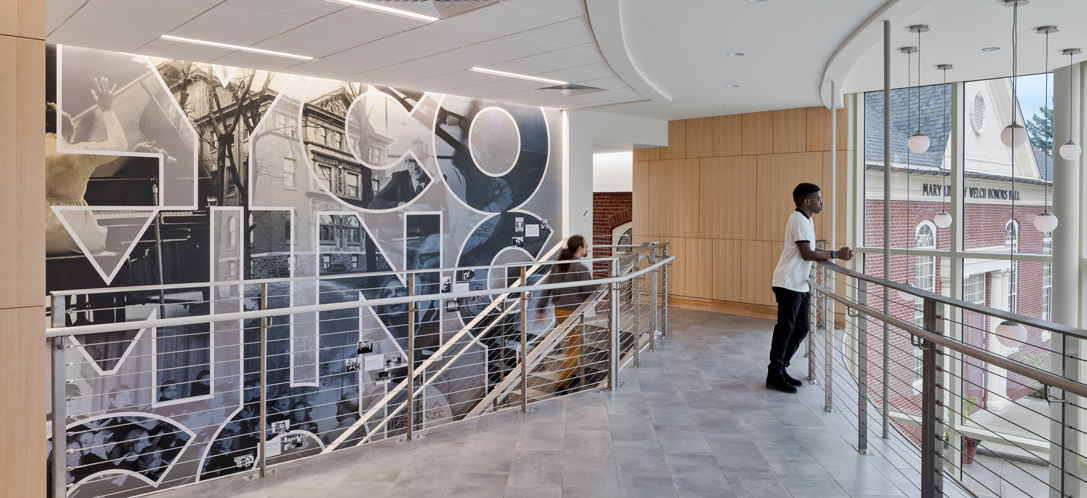
This digitally printed heritage mural in Lycoming College’s Trachte Music Center illustrates the music program’s evolution over 200+ years and deep community connections
Creating Spaces for Community and Ritual
Identity is shaped not only by what an institution believes, but by what it does. Spaces that support traditions, such as welcome ceremonies, student gatherings, musical performances, and community rituals, build emotional connection.
Thoughtful layouts, warm materials, and flexible gathering spaces help students shape memories. These design decisions reinforce students' sense of belonging by creating places where meaningful moments happen.
University of Saint Francis: Infusing Franciscan Values into Science Education
A project for the University of Saint Francis included the renovation of the existing Achatz Science Hall and an addition housing classrooms and laboratories. The higher education team at BHDP created an architecture and interior design strategy that embodies the institution’s Franciscan values.
The goal of fostering community is realized in bright collaboration spaces and design features like the grand stair, which features value statements including ‘Respect creation’ and ‘Foster peace and justice’.
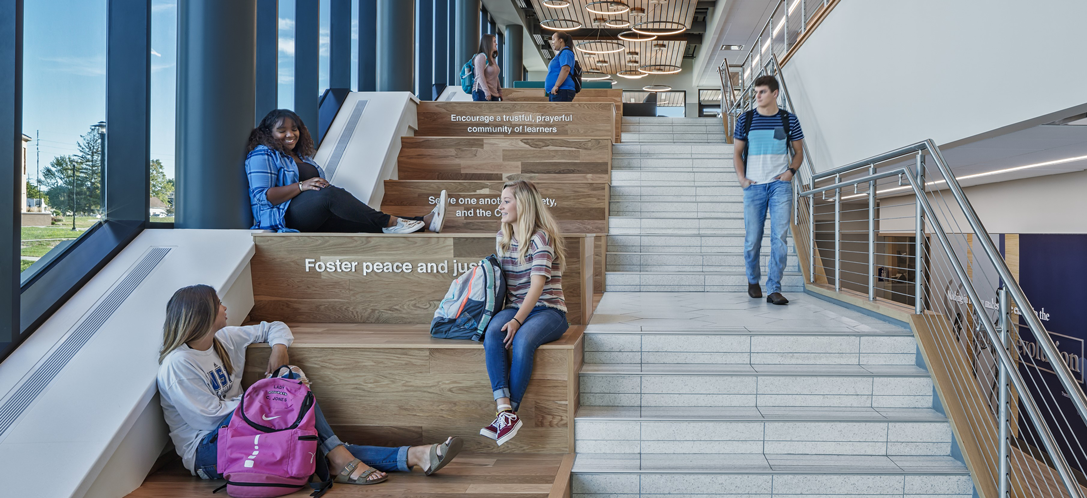
The grand stair at the University of Saint Francis’s Achatz Science Hall encourages collaboration between students and contemplation of the university’s values.
Designing for First Impressions - Visitors and Prospective Students
Cultural design elements aren’t just for current students. Prospective students take in every detail during tours, and impressions form surprisingly quickly. This form of branding ensures that visitors understand the institution’s values before they ever meet an admissions representative.
A Building That is Unmistakably Yours
To create a space that truly reflects your brand, institutions can start by asking:
- What differentiates you from your competitors?
- What daily behaviors do we want the building to encourage?
- What makes you most proud to be part of your institution?
- What results or outcomes do you take the most pride in?
- Which traditions define our sense of community?
These questions guide decisions that influence how to brand a university effectively while also building deeper resonance with students.
BHDP’s Holistic Approach to Building Unique Environments
BHDP brings a deeply collaborative process to every project, beginning with meaningful dialogue to uncover the culture, values, and traditions that make an institution unique. Instead of applying a generic design language, we work with key stakeholders to understand the character they want their spaces to express. In the collegiate context, this includes presidents, trustees, leadership, planners, faculty, staff, and students.
Our team blends strategy, architecture, interiors, and experiential graphic design to create environments that feel unmistakably “yours.” That could mean translating a mission statement into visual moments throughout a building, weaving historical cues into modern materials, or designing gathering spaces that reinforce community and ritual.
In a collegiate setting, the goal is straightforward: deliver appealing spaces that encourage enrollment, support student engagement, and make your brand tangible the moment someone walks through the door. When design reflects culture with clarity and intention, it naturally strengthens recruitment, retention, academic performance, and most importantly, creates a sense of belonging.
We Can Help You Design With Purpose
The most memorable designs reflect purpose and community at every scale. When architecture, graphics, materials, and narrative come together, colleges not only support student success but also strengthen their own identity in the process.
This is the impact of thoughtful university classroom design, intentional university brand strategy, and consistent brand management, unified into one cohesive story told through space.
Let’s tell your institution’s story through integrated and purposeful design.
Contact BHDP to see how we can help your institution embody your culture.
Author
Content Type
Date
February 09, 2026
Market
Topic
Campus Planning
Design Thinking


Derick Stadge, Higher Education Market Leader
With over 20 years in design and construction, Derick is passionate about turning ideas into meaningful built environments that leave a lasting impact on campuses, communities, and cities. His expertise spans design and planning, sustainable strategies, project management, construction administration, and client leadership. Derick has led a wide range of higher education projects—from labs and classrooms to residence halls and public spaces—managing varying scales, budgets, and complexities. His background working within a major university’s planning and design team gives him a unique perspective on strategic and capital planning, the design process, leadership, risk management, and the value of effective collaboration.