
Designing for Gen Alpha: The Future of Student Experience
Want to listen on another platform? Choose your platform here.
Episode Transcript
[Music Intro]
Brian Trainer, Host: Welcome to Trends and Tensions in Architecture and Design, presented by BHDP, where we discuss Trends in Architectural and Interior design and the competing priorities or Tensions that arise from integrating new ideas into existing organizations, enterprises, and institutions. In this episode, “Designing for Gen Alpha: The Future of Student Experience,” we are joined by Carmen Agouridis, Senior Associate Dean for the Martin-Gatton College of Agriculture, Food and Environment at the University of Kentucky, Jennifer Campbell, Professor of Pharmacy Practice for the College of Health Professions, Nursing and Pharmacy at Manchester University, along with AJ Medina, Higher Education Client Leader at BHDP. I am your host, Brian Trainer, Senior Strategist for BHDP. Let’s get started.
Today, we're having a conversation about Gen Alpha in higher education, and we have some guests with us that I'm gonna let them introduce themselves. If I could start with Carmen, please tell us who you are and what do you do.
Carmen Agouridis: Thank you for having me. I'm Carmen Agouridis, I am the Senior Associate Dean in the Martin Gatton College of Agriculture, Food, and Environment at the University of Kentucky. I oversee all of our academic programs at the undergraduate and the graduate level, and deal with the entire student life from the day we recruit them to the day we congratulate them as they walk across the stage at graduation.
Brian: Fantastic. Thank you, Carmen. And Jennifer, tell us who you are and what you do.
Jennifer Campbell: Excited to be here. I am a Professor of Pharmacy Practice at Manchester University in the College of Health Professions, Nursing, and Pharmacy. I've been at Manchester for 12 and a half years, and over that time I've done a lot of different jobs, one of which was working in student life, working with all of our health profession students, those in person and online, and supporting their in school and external needs. I currently am working as a full-time faculty member, teaching both on campus and with our online pharmacy students.
Brian: Thank you, Jennifer. AJ, tell us who you are and what you do.
AJ Medina: Hi! AJ Medina, I am a Client Leader here at BHDP Architecture, focusing on higher education, specifically on student life and what's going to be coming down the pipeline with the next generation.
Brian: Great, and that's what we're here to talk about. One of the key parts of this conversation is recruitment and the upcoming Gen Alpha. Can somebody tell me who Gen Alpha is?
AJ: Gen Alpha is the generation after Gen Z. Currently, the starting birth year is around 2013 or 2014, depending on exactly who you ask. We currently ascribe to the theory of it being 2013 and onward.
They don't have a full cutoff year date just yet. They're still being born, but people are predicting that'll be somewhere in the '25, '26 timeframe will be the cutoff till we name the next generation.
Brian: Great. What's so important about thinking about this generation? Is there something different about them? Why are we worried about Gen Alpha and recruitment at this point?
AJ: The biggest thing we like to think about as it pertains to higher education is that they're coming soon. They're about three to four years till they hit the halls, and we have known the differences between all of the generations. There's a lot of buzz about Gen Z, what they're like, what they're like coming into the workplace, what they were like in higher education. So, we know that these students have had a lot of different experiences in their adolescence and growing up, especially marked by COVID-19, among many other things going on in the world.
We're trying to plan as designers, as administrators, as student life staff members, how can we prepare to serve these students better in their higher education experience.
Brian: Great. Carmen or Jennifer, would you like to add to that at all?
Carmen: One of the interesting challenges as we get new buildings, and when you work in higher ed, it's not like it happens a whole lot for you on your campus, is you have to think about not just the students you're serving today, but what might be those students that you're serving tomorrow. And how can you design these facilities to meet all those myriad of needs that come through.
My children are right at that cusp when you talk about Gen Alpha, and it's really interesting to see some of those characteristics that come into play. When we thought about our buildings, it wasn't just the students that we have today, but thinking about those where they may be.
It's really interesting when I hear AJ talk about what Gen Alpha is and thinking, ‘wow, the cutoff point may be coming right up this year or right around the corner. What's the next generation gonna be?’ So, when our buildings were being designed, that key word that we thought about was flexibility.
When we build buildings in higher education, they may be here 50-plus years. We have to be flexible.
Brian: Yeah, that's a big investment. But what's different about this generation? Is there something about the way their social structures are organized?
AJ: Jen, you've got two of them at home. You've got a lot of first-hand knowledge.
Jennifer: I do. I have twins who were born in 2014. They started kindergarten during the fall of 2020. They started in masks, and there's a certain amount of desire to be present with each other that we don't see as much with the Gen Z’s. Because they were forced to be separated when they were young, I think there's a desire to reconnect. As we think about flexible spaces, as Carmen said, making sure that we have places where students can come and be together physically, and also how do we engage them online in a community space? There's an interest in that as well.
Brian: Carmen, I'll ask you this first. How does this come into play with your role and what you do?
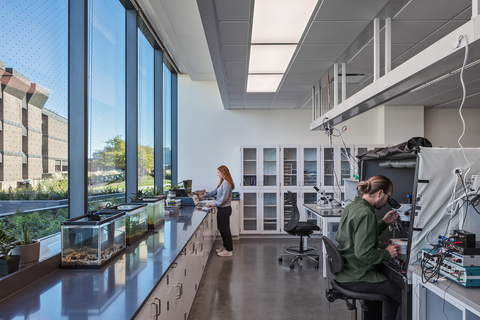
Carmen: Part of my responsibility is overseeing all of our teaching spaces. All the classroom spaces, all of our teaching labs. Our teaching environments aren't just the physical four walls that we have. They also extend into the online space. Some of ours extend into farms and forests and so forth. We may be having a class with students in Lexington that are also remotely joining with students at our Princeton Station in the western part of the state. When she was bringing up these points about this online environment and that flexibility, part of it is we have to be able to be multimodal in how we teach our students and utilize these spaces.
Our college is also heavily involved in extension, which is not just educating students, but also educating out into the public. When we designed our teaching spaces, we were keeping some of that aspect in mind as well.
Brian: Thank you for that. Same question to you, Jennifer, because I know your role right now, you're a professor, but before that, you had a very different role. How does one inform the other, and how is that important to what you do?
Jennifer: As a faculty member, I'm now all the time working in the classroom space. We have a distance pathway for our pharmacy program that's almost entirely asynchronous, meaning that the students aren't engaged at the same time. We're not in sessions like this, where we're on a call together. They're working on discussion boards or assignments. Thinking about how we engage students even in that platform to really bring that connection together.
My work in student life has told me that, although our distance students and our online students often have life circumstances that make it difficult for them to come online at the same time as someone else, they still wanna feel connected. So, how do we help them feel connected, feel like they're part of the community, even when they're not doing it at the same time as everyone else?
AJ: One of the things that I like about both of those answers and both of your programs and institutions is how you're meeting the students where they are, in the modality that they wanna learn in, and not at the expense of still being instructors and professors, knowing what they need in order to complete the program, but it's a really nice meeting in the middle.
We’re seeing an increased population in non-traditional students, right? We wanna make sure that we're tailoring to those needs that have families or existing careers, and they're trying to further their education. Or we have students that are really great with online learning, or really need that hands-on experience by going to the farms or having clinical placements or whatever it is.
It's a really cool time to be in higher education, where you can really have such a multifaceted approach to educating a student and using the best practices of education for the individual.
Carmen: A big part of what we think about, too, and we hear this a lot in education, the high impact practices.
What we think about when we have our instructors in the classroom is a lot of us may have come through the system. I'll be a Gen X-er here. And where a lot of times, we sat at a desk and we listened to a professor go up onto the board and write out equations, or talk, or even use PowerPoint or whatever, and that was the modality, right? We were the receiving vessel.
Nowadays, students are active participants in their whole learning journey. The classroom space has to also help be able to do that. All the spaces we wanted to be flexible. If I had an instructor that wanted to rearrange the room to do more group projects or whatever it may be, we wanted that flexibility in there.
A big effort I know that we're putting on right now at the University of Kentucky is trying to see how we have more students as partners in that education journey, so they are now more active participants in their own education.
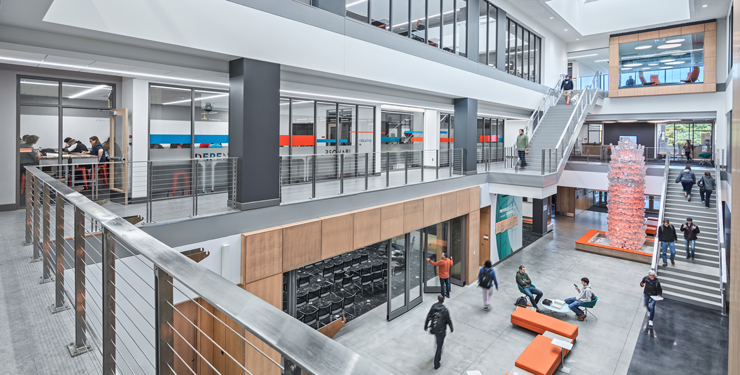
AJ: That's the learning inside the classroom, right? We know now there's so much learning that happens outside. Whether it's in student collaboration zones and faculties members walking by, cafes where groups are doing homework together, in the hallway or before and after class. There's so many places where learning happens, and transformation happens, that the classroom's really just the start of it.
Jennifer: When we did our renovation, adding those student activity spaces where students can meet together we call them huddle rooms, so rooms that fit about four students. Those get used so much on campus by students during the day. They like to be near each other and in a small group, but they're behind a glass door and wall. They can still see other people, but it's a little quieter. They have a whiteboard they can write on. Those spaces are really appreciated by the students. Again, having those different things that meet the desires of the different students is really great.
Brian: You were talking about the student activity spaces, and you said a little bit about what they are. So how are they supporting? Did you have spaces like that before? Is this a new concept? How do they best support the students?
Jennifer: We had a few spaces, not nearly as many as we have now. It was an intentional goal of the renovation we did to add more of these spaces.
We had a couple of rooms where the students could go in that were like these huddle rooms, and now we have many. I heard a student the other day said, "Oh, we're going to our study bunker," because they have a huddle room they go to. That's where they spend their evenings studying, and they have that space now where it's consistent for them. It's typically available, and everyone kinda of knows they're usually there. We're a small enough program, that's just kind of their space now. And there's enough of the huddle rooms that no one is fighting over them.
That was definitely a big part of our renovation, was adding more of these spaces and some additional furniture. All of our furniture was very clinical, I think maybe is a way to describe it. Like hard plastic chairs and round tables scattered around the building. We have a lot of other kinds of furniture, and the students really appreciate that. Like a comfy couch in the student life space where students can really relax and take those needed space breaks.
The health professions programs that are on campus, they're intense programs, and having that opportunity to have a little calm break from your class can really help a student be more successful.
Brian: Thank you, Jennifer. Carmen, have you experimented with similar types of spaces for your students?
Carmen: Yeah. The current buildings we are in now were built in the '60s. So, we took a space in our current building and made it into this little wellness area. It's darker, beanbag-type comfortable chairs, things that we do more holistic wellness programming. And that was a big hit with our students. When we were looking at the new building, we wanted to have at least a couple of activity spaces in the building.
Ours is a four-story building. Part of my office, Center for Student Success, will be moving to that building part into another one. We wanted some things about our college to really shine through. We're very relational, we're a very community-oriented college. Obviously, as the name implies, agriculture, food, and environment, we wanted a lot of natural elements or the feel of light in there.
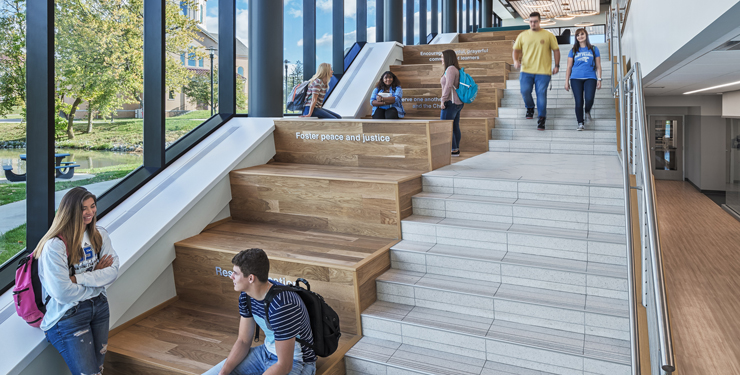
I hear Jennifer talking about a lot of those things. Places where students can come together and collaborate as large groups, as small groups, where they could sit and be exposed to the light. We even have a little bit of a balcony where they can sit outdoors. Those are all things that we were trying to think about because, if we've got the students comfortable in their spaces, we feel they're gonna spend more time here, and they're gonna be more engaged in this side of campus.
We also have a new café that will be coming in, and for us, that's huge because on our side of campus, we're quite honestly a food desert. Being able to have those kind of amenities in place is gonna be a huge aspect for us. But we're really thinking about those things that are outside of the classroom, those more holistic, wellness-type programming we wanted to bring in as well.
One space on our ground floor is an activity space that has more of those tables that you can do maybe a little bit more formal programming, stuff we could engage with our student leadership academy in place. The one on our second floor is like what we have right now, where less light can come through, but there is some. We'll do more comfortable seating in there. Depending on what your mood is that day or how you wanted to congregate, there's lots of those types of places around there. It sounds very much like the building Jennifer's describing in hers, each student can find their own little niche within the building that matches their best needs and personality.
AJ: You said something that I wanted to highlight. The importance of these spaces isn't just to create amenities. Yes, recruitment and enrollment is very important, especially as we head towards the enrollment cliff here in the next three years. Very important. But the whole point isn't just for enrollment and to have something shiny and nice.
The importance of these spaces and design, especially in an academic building, or academically focused building, is to drive those GPAs, those test scores, those study moments, those learning encounters, up to have better outcomes from the students' academic experience. Utilizing things as simple as if we provide food, they don't leave. They stay there, and they study longer. If we provide diversity of seating, a comfy chair for one size person, a more firm chair for somebody like me that has back problems, right? Then they're gonna sit in that chair longer. They're gonna study longer. That is going to help them throughout their academic career and into whatever they do after they leave the institution.
Brian: Thank you. Carmen. You had mentioned holistic wellness. What do you do to address holistic wellness, but also personal growth?
Carmen: Part of the university's strategic plan, UK Purpose is our strategic plan name, the first goal is putting students first. That was very intentional in the ordering in which that was done.
We look at everything through the lens of ‘are we removing barriers and are we creating opportunities for student success’, whatever that may be. When we look at a student, it's not just what is your current grade, but we have to think about all those factors that go into play within that.
When AJ was talking about all those other variables that help drive up student performance, we're thinking about those things. What is the mental health and wellbeing of the student? What is their financial health? What is the physical health? All of those different aspects come into play. Our role is to help support students in that entirety across that spectrum, so that they can be the best that they can be. So that when they graduate, they go out there into the world and they make a positive impact.
Jennifer: Manchester's mission, the first part of it, is to respect the infinite worth of every individual. That ends up playing out with our students in a similar way. We have what's called a mutual aid food pantry on campus. You take what you need, you leave what you don't. There's no sign-up, there's no qualifications. It's open any time the building is open. If students need something, if faculty needs something, if staff needs something, anyone is welcome to take the food from that and leave food there. We do fundraising for it, so Student Life will purchase items to replenish the shelves if that is needed, but it is there for students, because students today have lots of needs.
Food insecurity is a real thing for many of our students right now. Also, as part of that, we have a professional clothing closet, which is the same setup. If you have professional clothes that are gently worn and you're not using them anymore, you can put them in the clothing closet. If you need a suit or dress clothes, with the health professions programs, for a lot of our students, it's the first time they have to wear something professional. They maybe don't have the extra income to go buy nice clothes, professional clothes, so we have that clothing closet available.
Brian: Some of the things you're talking about are really good systems to support people on campus. You talked about online and being part of that experience because some people need that. That's their education style that works for their lifestyle, that helps them with balance. How do you create a good hybrid experience? What's the online experience at your university?
Jennifer: At Manchester, all of our students have a faculty advisor or mentor. On the health profession side, we tend to call them faculty mentors.
Health professions programs are largely cohorted programs, meaning all the students are taking the same classes at the same time. They're going through a standard curriculum. They don't need as much guidance on, should I take English 310 or English 315, right? There's one option. The faculty mentor serves in supporting them develop as a future professional, as a student professional, just supporting them through the program.
All of our students are also assigned a success advisor. Success advisors are relatively common on the undergrad side. We also do that on the graduate program side. When you're asking about how we find out about food insecurity, that's one of the ways. We have a staff member who's assigned as a success advisor. It's not one of their faculty members. It's somebody who can hear in a way that maybe the student feels a little more comfortable disclosing things to someone who's not also their professor. The students have both of those supports, and that's been really helpful in identifying concerns.
It's also how we help connect those online students. All the online students have the same connection points. They have a faculty advisor mentor. They have a success advisor. So that's one of the ways that we connect the students. All of our student organizations, students can participate in those, whether they're in person or online. We figure out great ways to host a trivia night where some students are in person and some students are online, or we host it entirely online for everyone so that students are still able to engage in community as they're in the online programs.
Brian: That kind of tagged on what I was curious about because you had the social spaces for people to gather, so you're creating virtual social spaces. What about you, Carmen?
Carmen: One of the points you asked earlier about that question of how do you know, and Jennifer, I think, hit a big one too. It's the people who are on the ground most often with our students. Whether it's our instructors in the classroom, whether it be our physical spaces online, whether it be our academic advisors. We use career and professional development mentors as well. All of those are interacting with our students. We have a central reporting mechanism at the university where somebody could go in and report the student has expressed issues from a whole range of things, and then that will connect them to a much broader group of central resources to help them out.
I imagine pretty much every university has some sort of system like that. What's really important, though, is that engagement, those front-line individuals like our instructors or so forth, that are with the students and doing that. And that is why it's so important to have spaces where our faculty and our students are always interacting, because they're gonna see that first.
For us, most of our online programs, at least in our college, are actually at the graduate level. And by the time you get to be a graduate student, you tend to be a better self-advocate. Not all the time, but you tended to be a little bit better in some of those areas. At the undergraduate space, all of our students, at least in our college, will meet each semester once with their academic advisor and once with their career professional development mentor to see that.
For our online spaces, this is something where creating that online community can be challenging, especially if you're in an asynchronous environment because you're not talking. Ao much of what we do as humans is we pick up on non-verbal cues, not just the verbal ones. I do think that's an area I will say we can continue to grow in, all of us who try to teach in that online space can continue to try to grow and do better in.
Brian: Thank you for that, Carmen. Now, I've come to the end of the really cool questions that I had written in advance, but I feel like we could talk for another hour. But before we go, I just wanted to give you another opportunity. Is there any parting thoughts you would want listeners to have? Anything on your mind related to either Gen Alpha or the future of your industry that you'd like to share before you go?
Carmen: I think the smartest thing we did when we started designing our facilities was talk to the students. Get a feel for what it was that they liked and they didn't liked, and what they hoped and dreamed for in a new building. Anybody going down this path, there is a lot to be said for figuring out what your North Star is when you're designing, because lots of people are gonna pull you along the way in many different directions.
But also having that student voice to be a part of it, because at the end of the day, that's really what we were designing these facilities for. The other part I would say is be flexible. We were very intentional in not designing rigid spaces and rigid furniture that couldn't be moved. What we imagine and we think is gonna happen in the next 10 years, this building may be here 100 years, and we have to have that flexibility for it to grow with our students as well.
I would encourage whoever goes down this path, the best thing we did was really talk to our students, listen to our students, and design knowing that our future is gonna change. It's organic, and we have to be prepared for that.
Jennifer: I couldn't agree more with the flexibility, that need, and meeting students where they are.
Being open to hearing the student experience and the experience the students want and what they maybe need now is different than what we experienced as students. Being willing to adapt and change and look at what is going to best serve that student to make their experience something that prepares them in the health professions to be that amazing healthcare professional.
We want students to be able to learn and grow, and have that care of the whole person because that's what we want when they graduate. How can we help care for them as a whole person, and support them, and hold them accountable, just like we care for the whole person and hold the patient accountable out in the practice setting.
Brian: Thank you, Jennifer. AJ, any final thoughts?
AJ: When you say the word Boomer, X-er, Millennial, Gen Z, certain key things come to mind. We're trying to plan for Gen Alpha and then what comes after that. When you say the word classroom or college, we all probably have very similar mental picture or laboratory, right?
How do you take something that has a permanence, such as architecture, and adapt it to something that is constantly changing, which are the traits of generations and humanity. That's the puzzle we're all trying to figure out together, both from the architectural side and the educator side, in order to just provide really great experiences and great students that go into the workforce.
Brian: Thank you, AJ. Carmen, Jennifer, thank you both for your time. I hope you had fun. I know that I did, because I actually learned some things, which is always a good day for me. Thank you very much.
Carmen: Thank you very much for having me. This was an absolute pleasure.
Jennifer: Thank you.
[Music Outro]
Brian: Thank you for joining Trends and Tensions in Architecture and Design, presented by BHDP. For this episode, "Designing for Gen Alpha: The Future of Student Experience", with Carmen Agouridis of the University of Kentucky, Jennifer Campbell of Manchester University, and AJ Medina of BHDP. If you appreciate what you have heard, please rate, subscribe, and give us a review. I am Brian Trainer, your host, and I hope you'll join us for another episode of Trends and Tensions to see what topics drive design.
Author
Content Type
Podcast
Date
March 31, 2026
Market
Practice
Topic
Campus Planning

Brian Trainer, Senior Strategist
Brian’s energetic and passionate personality facilitates a strong connection with his clients and keeps him in tune with their vision, which is key to BHDP’s design strategy. His commitment to front-end strategic engagements allow him to better understand a client’s business drivers, workplace organizational culture and workplace dynamics–ultimately priming a project for success. Brian ensures that this success continues even after a project is finished; he is Prosci Change Management Certified, giving him solid expertise when guiding clients through the workplace change. Brian’s well-rounded qualifications and diverse architectural background guarantee that every project produces long-standing results.
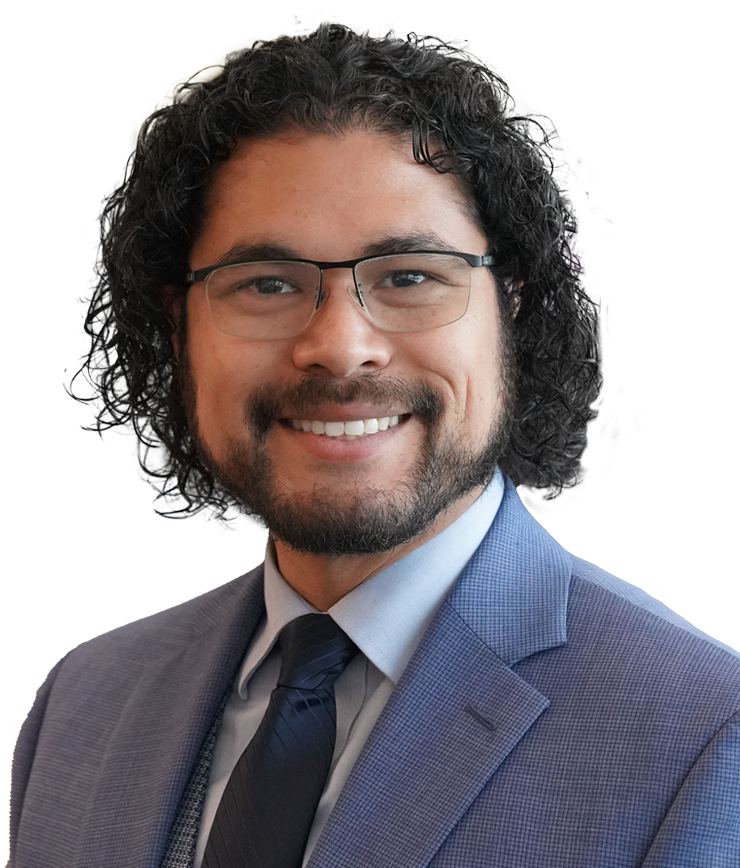
Alejandro J. Medina, Client Leader
With over 16 years of experience, Alejandro J. "AJ" Medina works closely with his clients to understand their vision and values, identify strategic goals, and translate this understanding into the design of physical space that promotes the vision, values, and specific project goals. He builds strong relationships with his clients and successfully coordinates the efforts of architects, engineers, and key client stakeholders. AJ’s experience includes visioning, programming, and design for new construction and renovation projects, including student life, collaborative learning environments, health sciences education, athletics, residence life, and research and teaching laboratories.