
The Role of Campus Tours in the Digital Age
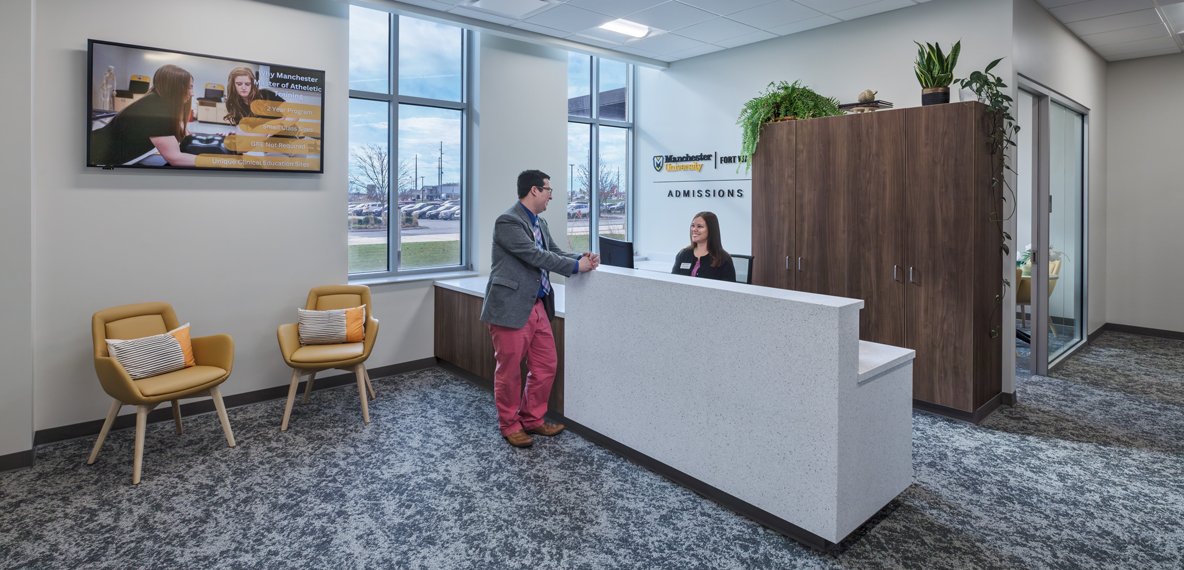
Higher education is increasingly a digital world, but the in-person campus visit continues to be one of the most decisive moments in a student’s search. Brochures, reviews, and pamphlets can only go so far. The campus tour is the one experience that turns curated information into lived reality.
Virtual tours are excellent for access and early screening: they help students compare programs, review amenities, and narrow a list efficiently. But when it comes time to choose, students and families still lean heavily on being there. One national survey found 84% of students included a campus visit in their college search, and nearly 90% of those visits were in person rather than virtual.
What the in-person tour uniquely delivers is a sense of place: it converts “interest” into belonging and abstract claims into tangible evidence through real experiences. It also supports conversion: campus visits help build enough emotional confidence to withstand comparison and price pressure, and the in-person format is where authenticity shows up best, especially in human moments. Campus visits are a top preferred method for researching an institution, with that statistic rising by 9% in recent years.
In this blog, we explore why in-person campus visits are so pivotal and highlight key hot spots that turn walking buildings into memorable moments, yielding higher enrollment rates.
Creating a Sense of Place
While visiting the campus, students can envision themselves in different settings–common areas, learning centers, residence halls, etc.–when they see current students engage with these spaces. Evoking that sense of belonging, or place, is therefore essential. The campus tour helps students forge strong bonds with an institution by:
- First, campus tours convert “interest” into “belonging.” Digital content can explain programs and rankings, but an in-person tour creates an emotional read on fit—culture, community, energy, and whether a student can picture themselves there.
- Next, they build trust by validating the online story. Prospects arrive with impressions formed by websites, social media, and virtual tours; the campus visit confirms (or contradicts) that narrative through authenticity—real students, real spaces, and unfiltered day-to-day cues.
- Finally, they influence decisions through experience of place. Experiencing the campus firsthand—wayfinding, comfort, accessibility, residence life, dining, academic spaces—turns abstract claims into tangible evidence, and that often becomes the “deciding factor” between similar institutions.
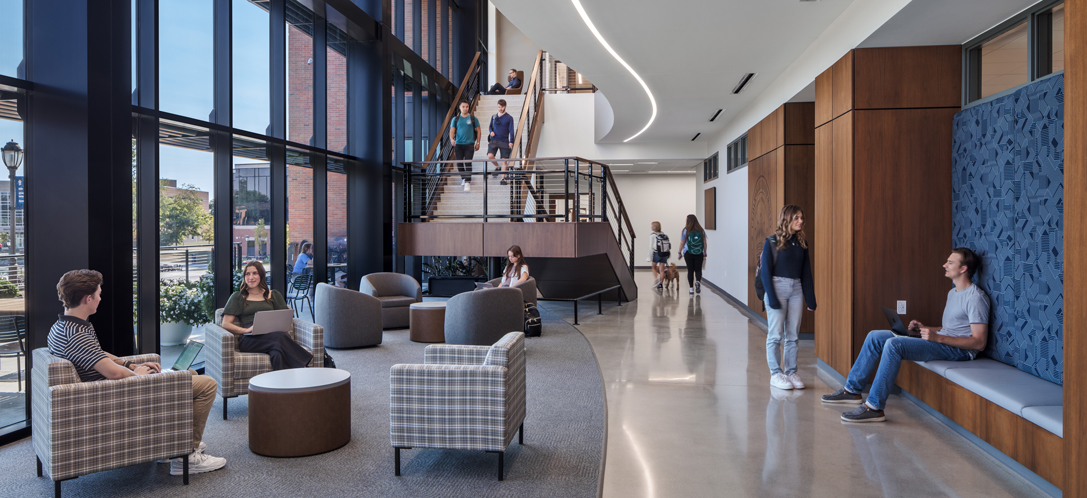
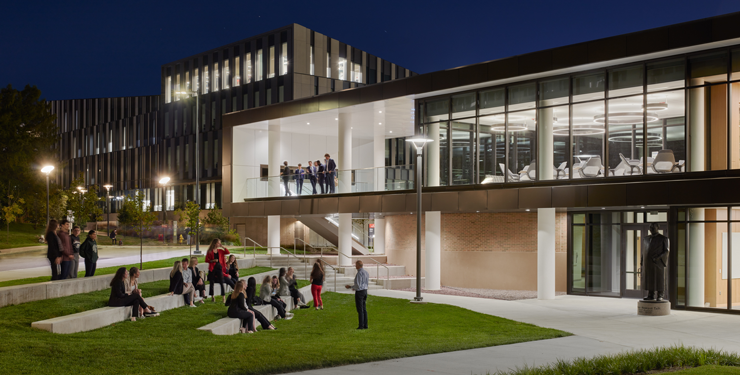
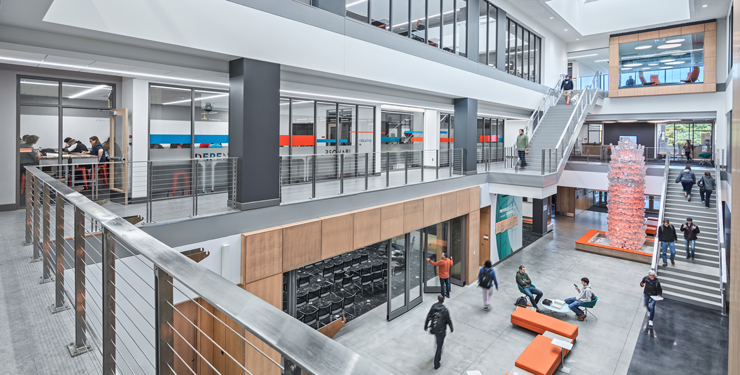
The Scharnberg Business and Communication Center at Cedarville University is a dynamic facility that fosters collaboration within the campus community. | View Project
Converting Visits to Enrollment
There is a clear relationship between campus visits and conversion from acceptance to enrollment: the fewer campuses a student visits, the more likely they are to enroll at their first-choice institution. Conversely, a higher number of visits correlates with students selecting a backup option. In BHDP’s enrollment survey, students who made 1–2 campus visits were 51% likely to attend their first-choice institution. Pair that with the most common reason students don’t attend their first choice—cost (40.4%)—and it becomes evident that getting a student on campus while your school is their top choice is a powerful driver of yield. It builds emotional commitment and confidence early enough to withstand price and comparison pressure. In contrast, students who visited 5–6 campuses were 61% likely to select one of their backup schools, underscoring how competitive “shopping behavior” increases the risk of being compared out of the running altogether—even after admission. For institutions that are not the initial favorite, this highlights the strategic role of the visit experience: creating belonging, demonstrating value, and delivering a differentiated story (academics + student life + outcomes) that can move an institution from “backup” to “best fit.”
Key Hot Spots: Where the People Are
Campus life is multifaceted. Students want to feel a return on personal investment when they spend time in these different and varied spaces. From buildings that are well-known and universal, like libraries, to the more transient nature of student affinity groups and clubs, being included fosters a sense of attachment.
Library
Academics remain the primary reason students choose an institution, and in our survey, 70% of students ranked academics as “Extremely Important” or “Very Important”. This is precisely why the library is such an effective (and efficient) tour stop. It’s hard to showcase every academic building a prospect might use (and not every department space is recently renovated), but a strong library or learning commons lets students immediately picture where they’ll actually spend focused time: studying, collaborating, getting tutoring/writing support, using technology, and finding quiet. A well-renovated library signals institutional investment in student success and becomes a “shared front door” for learning across all majors—conveying both collegiality and prestige.
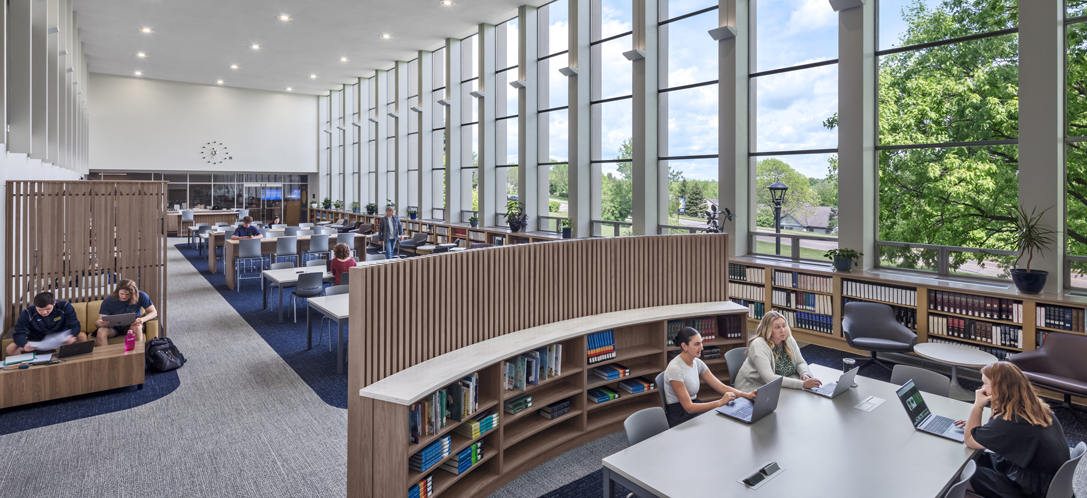
The Archbishop Alter Library at Mount St. Joseph University in Cincinnati, Ohio, provides a light-filled student learning commons experience while maintaining a rich catalogue of books.
For example, in 2021, Mount St. Joseph University enlisted BHDP to renovate its Archbishop Alter Library. Once a bustling academic hub, the library, built in 1962, had seen little modification and steady decline in patronage in the ensuing years. BHDP’s design included a more contemporary and inviting entrance, a centrally located circulation desk, and an array of student support spaces. Completed in 2023, the library saw a nearly 50% increase in patron traffic in the fall semester following the renovation. Archbishop Alter Library is an excellent example of the integral nature of a library on a collegiate campus. Not only is it a destination spot on prospective student tours, it’s also a tangible outlet for donor investment that touches every campus and community member who passes through its doors.
A multi-year study in College & Research Libraries found that students in courses with a librarian-led instruction session had a statistically significant higher chance of being retained, with retention differences reported in a 2.8–8.9 percentage-point range across multiple years. The ACRL has also summarized evidence that students who use library services (instruction, spaces, consultations, resource access) tend to show stronger academic outcomes, such as GPA/grades and retention, compared to peers who do not.
Student Life
Student life buildings (student unions, rec/wellness, clubs, and org space) are critical on campus visits because they’re where prospects can see themselves belonging day to day. In our survey, student life ranked as the 3rd highest factor influencing college choice, with 60.5% of students rating it “Extremely Important” or “Very Important.” These spaces make the institution’s culture tangible — whether a student is looking for clubs, intramurals, events, leadership opportunities, or simply places to study and meet friends—turning the tour from “good academics” into “I can thrive here.”
This matters even more as Generation Alpha approaches higher education with expectations around holistic wellness and personal growth, not just classroom success; campuses that visibly support mental, physical, and social wellbeing communicate that commitment instantly. And the time impact is real: national engagement research shows students commonly spend meaningful time each week in co-curricular activities and socializing (e.g., NSSE reporting on student time use), which reinforces that “campus life” isn’t a side story—it’s a major part of the lived experience the tour is trying to demonstrate.
Residence Halls
Long-standing as a key driver in institutional selection, residence halls are often the most “make-or-break” stop on a campus visit because they show prospects (and their families) what daily life really feels like—comfort, safety, community, and independence. Housing is also one of the easiest places for a visitor to do an instant value check: “Can I picture living here, studying here, and making friends here?” That’s why many tour programs smartly focus on a single, well-staged room or suite—done right, it communicates the baseline quality, finishes, storage, privacy, and social space expectations in just a few minutes. Housing outcomes data helps reinforce why residence halls deserve that spotlight: ACUHO I/NSSE research reported first-year students who live on campus persist to the second year at a rate about 2.0 percentage points higher than peers living off campus independently (92% vs. 90%).
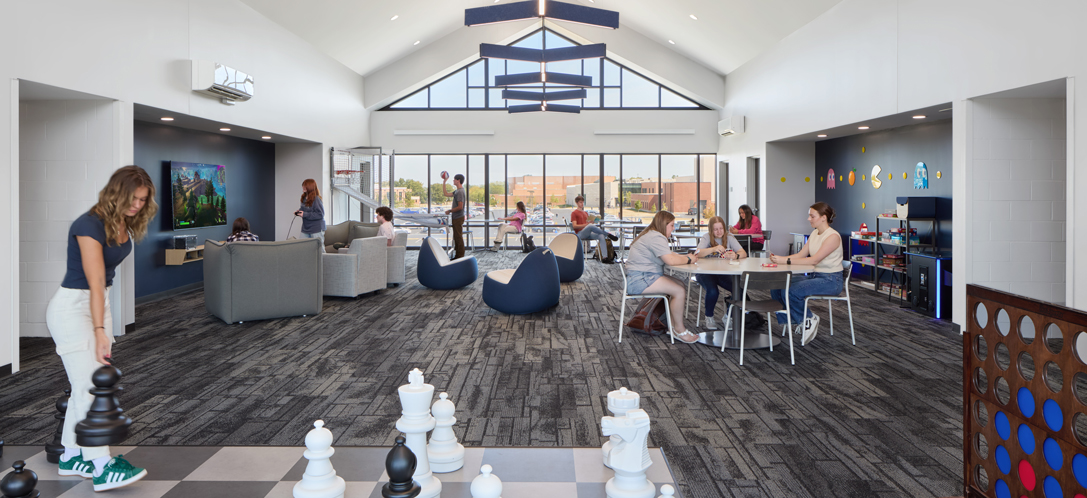
Premier commons spaces the Residence Halls at Cedarville University in Cedarville, Ohio allow visitors to get a sense of the “home away from home” community they will have.
At Cedarville University in Cedarville, Ohio, BHDP developed a residence life master plan calling for four new residence halls arranged around a central residential quad. The design promotes interaction and academic success and features several community engaging focal points: central and corridor-level social lounges, dedicated study areas, shared laundry, and other amenities.
Research Buildings
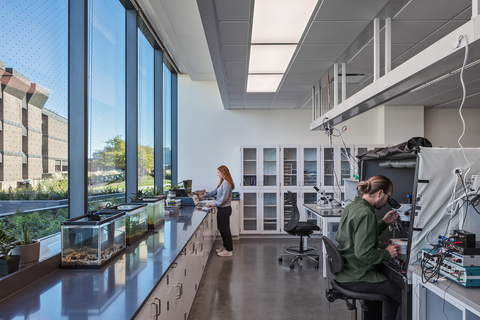
Research is one of the most compelling “future-facing” moments on a campus tour because it makes innovation visible and personal. For high school seniors, walking past a glass-walled chemistry lab, robotics bay, or makerspace turns academic programs from a brochure claim into a lived experience: This is what I could do here. For parents, research environments signal rigor, safety, investment, and momentum: active labs and well-supported faculty/student teams communicate that the institution is building opportunities, not just delivering lectures.
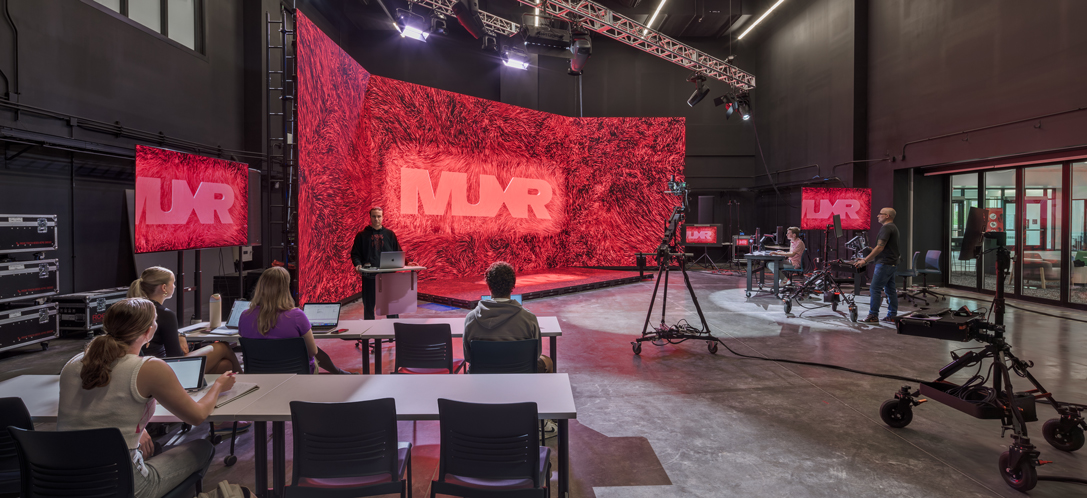
The XR Stage in the McVey Data Science Building at Miami University in Oxford, Ohio displays research as people pass by. | View Project
The best tours intentionally choreograph a quick, authentic “research-in-action” moment (a demo, poster session, student working at a bench) because it creates a memorable story that prospects repeat afterward—and those stories drive confidence and enrollment. There’s also a strong outcomes narrative to pair with the inspiration: employers consistently rate core skills like critical thinking and communication as “very/extremely important” at ~96% in NACE reporting, and authentic research settings are one of the clearest ways to demonstrate how students will practice those competencies before graduation.
Athletics Venues
Athletics venues can be a surprisingly high-impact stop on a campus visit because they make “campus life” feel real. At smaller institutions, athletics can be directly tied to enrollment strategy—recruited athletes may represent a meaningful share of incoming students and help stabilize headcount. At larger institutions, major venues function more as community infrastructure: they showcase school spirit, tradition, and weekend energy, which helps prospects imagine belonging beyond the classroom.
Conclusion
In the digital age, virtual tours help students discover and compare institutions—but in-person campus visits are where decisions get made. The physical experience of campus converts information into conviction: students test “fit” through a true sense of place, validate (or challenge) what they’ve seen online, and start to imagine a day-to-day life that feels motivating, safe, and socially connected. Just as importantly, the visit is a yield moment. When a campus tour is intentionally sequenced to tell a clear story and anchored by high-impact “hot spots” like the library, student life spaces, residence halls, and visible research activity, it can turn a prospective student’s uncertainty into confidence, and confidence into enrollment.
In short, tours aren’t just a walk; they’re a strategic experience that communicates priorities, investment, and belonging in a way no webpage can fully replicate.
BHDP Can Help Create Connection on Your Campus
If your tour route isn’t consistently reinforcing the story you want students (and parents) to believe, you’re leaving conversions to chance.
BHDP can help you evaluate the current tour experience as a connected system: from arrival and first impressions to the “moment that matters” spaces to the path in between.
We’ll work with your enrollment and facilities teams to:
- Assess the state of key tour buildings and the gaps between the brand promise and the lived reality.
- Identify quick wins to immediately lift perception.
- Build a prioritized renovation roadmap aligned to the tour spine.
Reach out to BHDP today to strategize investments your students will see, feel, and remember.
Author
Content Type
Date
March 06, 2026
Market
Topic
Campus Planning

Alejandro J. Medina, Client Leader
With over 16 years of experience, Alejandro J. "AJ" Medina works closely with his clients to understand their vision and values, identify strategic goals, and translate this understanding into the design of physical space that promotes the vision, values, and specific project goals. He builds strong relationships with his clients and successfully coordinates the efforts of architects, engineers, and key client stakeholders. AJ’s experience includes visioning, programming, and design for new construction and renovation projects, including student life, collaborative learning environments, health sciences education, athletics, residence life, and research and teaching laboratories.