

The Future of Workplace in Charlotte: Understanding Market Dynamics and Strategic Implications

Real estate is being redefined from a cost center into a performance-driven business asset. Charlotte is entering a new phase of stability and transformation, but the underlying story is bigger than market cycles. The convergence of hybrid/return-to-office pressure, rising costs, and AI-driven change is fundamentally reshaping:
- How companies use space
- How often employees come in
- What the office is expected to deliver
At the same time, the Charlotte market reflects several broader shifts. Strong leasing momentum, led by corporate office space users, is on the rebound. Demand is increasingly concentrated in high-quality, amenitized Class A assets. New construction remains limited, tightening the availability of premium spaces. And finally, capital pressure is on the rise as tenant improvement costs increase.
What Matters Today
The market is stabilizing, but expectations for workplace and real estate have fundamentally changed. The bigger shift is in how companies think about the workplace, from managing space to driving performance, supporting talent, and creating long-term value.
Charlotte Leasing Market
Charlotte’s office leasing market is regaining momentum, driven by corporate office space activity and improving absorption. Yet demand is increasingly focused on a smaller group of high-quality assets. As vacancy stabilizes, the market is separating between high-performing buildings and those that require reinvestment, shifting how tenants evaluate location, amenities, and overall workplace experience.
Leasing Activity and Demand
Leasing activity in the first quarter of 2026 was robust, including large corporate office relocations and expansions in Charlotte, as well as continued renewals and commitments from existing tenants. Befitting the second-largest banking center in the United States, financial services continue to dominate leasing activity. According to Colliers, JP Morgan, Scout Motors, and Charles Schwab all committed to leases of sizeable square footage in the metro region. Several other tenants took on leases averaging 20,000 SF throughout the central business district.
Overall, leasing volume hit ~1.5M – 1.6M SF in Q1 2026, one of the strongest quarters since the pandemic.
Vacancy and Absorption
Per a Q1 report from Colliers, vacancy in the Charlotte office market dropped to 16.6% in March, the lowest rate since late 2023. Broader inventory definitions put the vacancy rate in the 24% - 27% range. Overall, vacancy is steadily declining in recent quarters. The rising trend is a return to positive absorption throughout 2026.
Key Leasing Trend: Flight to Quality
For newer assets built within the last 10 years in Charlotte, vacancy is even lower, sitting at roughly 13.6%. These buildings offer several demand drivers that set them apart from others. These include:
- Location: Central Business District, South End, SouthPark
- Amenities: Hospitality, wellness, transit proximity, mixed-use access
- Experience: Brand presence and employee experience
Older assets remain available but require significant reinvestment or repositioning to compete. In Charlotte’s office market, newer, higher-quality assets command significantly higher rents than older stock. This gap is widening due to supply constraints and tenant preferences. Trophy office rents have led the market, increasing by approximately 26% over the past six years – equivalent to an average annual growth rate of 4.3%. By comparison, Class A rents have grown at an average annual rent of 2.8%, while Class B rents have increased by roughly 2.2% per year.
Workplace and Relocation Trends
Companies are making relocation decisions differently. Workplace strategy is now a central driver, shaping not only where organizations choose to locate, but how they configure and deliver space.
Demand is shifting toward flexible, move-in-ready environments that support hybrid work, accelerate occupancy timelines, and enhance employee experience. As a result, relocation decisions are increasingly tied to talent access, speed, adaptability, and the ability to create a workplace that reinforces culture and business performance.
Corporate Office Space Relocation
Thanks to strong job growth and population inflow in Charlotte, corporate office space expansions lead the way in bringing more people into the city.
Maersk has moved its North American headquarters to Charlotte, creating 520 jobs and investing $16M, strengthening logistics and supply chain operations. SMBC Group is establishing its second U.S. headquarters in Charlotte, investing $50.5M and creating 2,000 jobs over six years in the financial services sector.
Population and Growth Trends
Charlotte ranks among the fastest-growing U.S. metros, adding 280,000+ residents since 2020. The region now exceeds three million people, reflecting sustained long-term growth. Over 150 people move to Charlotte daily, reinforcing strong inbound migration. This growth is distributed across the metro – not just limited to suburban expansion.
Workplace Strategy Shifts
As market dynamics continue to shift, demand is following suit. Spec suites and plug-and-play spaces are more desirable than ever. Flexible workplace footprints and hybrid-supportive environments help businesses accommodate employees with diverse in-office needs and expectations. The workplace that enables hot desks and high-value, in-person collaboration will increasingly beat out those that isolate and silo employees, many of whom are already averse to the perceived hassle of in-office work.
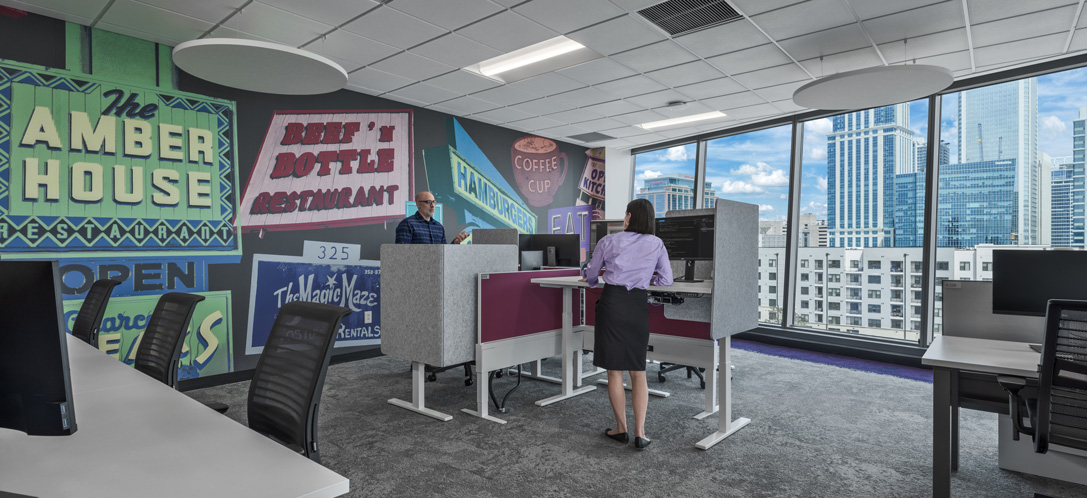
WTW’s Charlotte office, on the sixth floor of the Vantage Building’s East Tower, includes collaboration areas, huddle rooms, and space for focus work – plus a prime view of downtown Charlotte.
Companies are increasingly prioritizing:
- Talent attraction and retention
- Culture visibility
- Collaboration and experience
Relocation Decision Drivers
Just as the market is experiencing a shift in priorities, clients are, too. They’re considering four primary decision drivers for relocating staff and offices to different regions like Charlotte. These include:
- Talent access, with an emphasis on urban and amenity-rich neighborhoods
- Speed to occupancy – move-in ready spaces versus full buildouts, both with respective merits and disadvantages
- Experience over efficiency – priority for how the workplace feels and performs for people, over square footage, HVAC efficiency, and energy use
- Flexible lease structures and future adaptability – spaces that can accommodate growth are more desirable than fixed confines
Tenant Improvement (TI) and Fit-Out Environment

An office designed to maximize work performance and output in Columbus, Ohio
The tenant improvement environment has become one of the most critical and complex elements of real estate decision-making. Rising construction costs, longer delivery timelines, and increased workplace expectations are putting pressure on both budgets and schedules. Landlords are adapting through higher TI allowances and more flexible deal structures, shifting how value is created in a transaction.
For occupiers, this elevates the importance of how space is designed and delivered, as decisions made during programming and fit-out now have a direct impact on total occupancy cost, speed to market, and long-term performance of the workplace.
Cost Landscape (2025-2026)
Average office fit-out cost: ~$149/SF, up ~5.5% YoY
- Typical office TI ranges:
- Open/collaborative: $65-$115/SF
- Private office: $95-$165/SF
Cost drivers impacting budgets:
- Labor shortages and wage growth
- Material volatility (steel, copper, systems)
- More complex tech (AV, hybrid infrastructure)
- Sustainability requirements
Landlord Behavior
TI allowances increasing:
- ~7% YoY in Class A environments
- Some markets seeing up to 20% increases
Strategic Insights
- Second-generation space can reduce costs by $20-$40/SF
- Many deals now include:
- TI escalation clauses
- Increased landlord participation
Design decisions are now a financial strategy lever, not just a workplace decision. Fit-out construction costs do not include IT, AV, security, furniture, fixtures, & equipment (FF&E), and soft costs.
Supply, Development, and Investment
Charlotte’s office market is being driven by limited new supply and continued investment in high-quality assets. With few new developments and increasing focus on repositioning existing buildings, the market is tightening at the top while creating opportunities for reinvestment in underperforming properties.
- Office pipeline is thin: Queensbridge Collective is the only major project under construction and largely pre-leased.
- Broader trend: Limited new product means a tighter supply of larger blocks.
- Active capital markets: Trophy assets are trading at high values. One of the most significant sales recently includes 300 S. Tryon, a 25-story, 638,000 SF office tower. The building was purchased by Cousins Properties, a CRE firm based in Atlanta, for $317.5M.
- Repositioning trend: Investors are increasingly targeting underperforming assets. Their approach entails repositioning these properties through amenity upgrades and conversion (office to hotel or mixed-use). To that end, the Charlotte market is seeing more office-to-hospitality conversions emerge.
Rental Rate and Economics
While Charlotte’s average asking rents provide a useful benchmark, the more meaningful story is how pricing varies across asset quality and how that impacts tenant decisions. The market is increasingly separating between high-performing, amenitized buildings that continue to command premium pricing and older assets that require investment to remain competitive.

The Fifth Third – Project Connect lobby in the central business district of Cincinnati, Ohio.
This divergence is being reinforced by stronger rent growth in top-tier properties and more flexible economics in commodity space. For occupiers, the focus is shifting beyond headline rent toward understanding total cost, value, and the tradeoffs between rent, tenant improvements, and long-term performance.
Average asking rent: ~$34.57 - $34.83/SF
Premium space:
- Higher rents, fewer concessions
- Higher retention rates
Growth:
- Tier 1 assets outperforming materially:
- ~8.4% annualized growth vs ~3.2% market-wide
Commodity Space:
- More negotiable
- Requires capital investment to compete
Real Estate Strategic Implications
Charlotte’s office market is pushing organizations to make more deliberate and forward-looking real estate decisions. The focus is shifting to speed and flexibility while better aligning space with how teams actually work, and making more intentional choices about where to invest, where to consolidate, and how to get more value from existing space. Organizations that act early and take a more disciplined, strategic approach are better positioned to secure the right space, manage costs, and support long-term business outcomes.
Leasing Strategy
To achieve optimal return on investment, these four points can inform your potential leasing strategy. In a rapidly shifting market, keeping an eye on stalwart features can mean the difference between a successful in-office experience and one that falls short.
Prioritize
Narrow in on high-quality, well-located assets from the start. Engaging early puts you at an advantage in a market where premium availability is narrowing by the quarter.
Relocation Strategy
Consider your timeline for moving in. What is more valuable for your business – a fast move-in or a slower pace with more customization? This could mean taking a space on spec or opting for built-to-suit. Also consider the impact a given workplace will have on your talent and your overall culture.
Align Design and TI Strategy
Determine how you will balance your budget for design with any tenant improvement allowances offered by your landlord. Keep in mind the potential need for long-term flexibility, brand changes, and employee experience.
Portfolio Strategy
A new lease is an opportunity to optimize your overall portfolio strategy. This can look like consolidation to fewer, higher-quality locations or leveraging landlord TI for upgrades in your existing buildings.
Step Into the Future of Workplace in Charlotte with BHDP
The future of workplace in Charlotte looks bright. Leasing activity is stabilizing, with improving fundamentals across the market. Companies are using real estate to attract talent, support hybrid work, and reinforce brand and culture. Rising costs make early, intentional decisions critical.
BHDP has a deep well of knowledge and expertise in strategic build-outs for tenants, in everything from high-performing, amenitized Class A space to underperforming assets requiring reinvestment.
Fill out the form to see how BHDP can help you navigate the office market.
Author
Content Type
Date
June 16, 2026
Market
Topic
Workplace Strategy
Hybrid Work



Eric Palomino, Client Leader
Eric brings over 20 years of experience as a global real estate and facilities executive to his role at BHDP Architecture as Workplace Client Leader. With a passion for corporate interiors and retail environments, he is adept at real estate strategy, capital project planning and delivery, site selection, and portfolio optimization. Eric translates business goals into physical environments that are functional, flexible, and human-centered.