

Healthcare Design Conference Recap: What Our Team Can’t Stop Thinking About
This year's Healthcare Design (HCD) Conference brought the BHDP Healthcare team to New Orleans, where the energy of the city matched the momentum building across the healthcare design industry. Beyond leading two conference sessions, three days were spent connecting with peers and partners, trading perspectives, and pressure-testing the ideas shaping the future of healthcare environments. What emerged was a shared recognition that the stakes are shifting. From net-zero realities and measuring the true impact of our spaces to the economic forces reshaping how and where care happens, the team came home with a lot to unpack.
The following team members shared their key takeaways and main themes that resonated throughout the conference.
Mindy Graves: Transforming Facilities into Strategic Enterprise Assets
Hospital systems and healthcare clients are continually being asked to do more with less. The conference sessions I attended point to a fundamental shift in healthcare infrastructure strategy: organizations must move beyond viewing facilities as individual construction projects and manage them as integrated, adaptable assets that support clinical outcomes, financial sustainability, and long-term organizational strategy.
- Treat facilities as strategic assets, not simply physical infrastructure. Integrate facility planning with enterprise strategy, clinical service-line planning, financial performance, and community needs.
- Make prefabrication and modular construction an operational strategy. Integrate modular construction into capital planning, design standards, procurement, project delivery, and facility operations. Develop repeatable approaches that can scale across the portfolio.
- Prepare for AI-enabled facility and infrastructure management. Artificial intelligence has the potential to transform healthcare facility operations through predictive maintenance, operational analytics, automation, resource optimization, and improved decision-making. However, to realize this potential, you need reliable data, interoperable systems, well-defined workflows, and clear accountability.
- Balance standardization with flexibility. Establish enterprise design standards that define what should be consistent and where flexibility is essential. Use performance-based requirements, adaptable infrastructure, and lifecycle cost assessments to avoid overdesign while preserving future options.
The most important takeaway and strategic implication is that healthcare facility performance must become an enterprise management responsibility rather than remain primarily a construction and facilities function. The organizations best positioned for the future will be those that combine innovation with disciplined execution—using existing assets more effectively, standardizing where it creates value, preserving flexibility where it matters, and measuring performance throughout the facility lifecycle.
Bryan Ruby: Justifying Sustainability, Defining Success, and Maximizing Value
Net Zero is Hard to Justify: Top design firms evaluated “good, better, and best” strategies for achieving net zero energy across MOBs, ASCs, and hospitals, and the results were disappointing. Using example projects in urban and suburban Oregon, where clean energy is readily available, one study found that achieving net zero was theoretically possible but difficult to justify financially. Even when combining high-performance building envelopes, passive design strategies, and efficient active systems, the most aggressive approaches did not demonstrate a return on investment within maintainable life cycles. In order to implement sustainable design strategies, systems and design teams need to establish clear goals early and run careful cost analysis. This will allow teams to identify the right balance of strategies, maximize performance, and recognize when additional investment begins to yield diminishing returns.
Analyzing Success: Healthcare systems and design teams are increasingly looking beyond project completion to define what success actually means and determine which measures are most meaningful at different scales. Simple approaches are emerging, including establishing baselines and documenting outcomes through surveys, while more advanced options involve third-party data collection and analysis. Regardless of the approach, the key is to gather reliable, evidence-based data that can inform both current projects and future decision making. Whether driven by designers through targeted surveys or supported by specialized data firms, these efforts can help teams better understand project outcomes, identify opportunities for improvement, and develop strategies that more accurately predict future performance.
Economic Outlook: Although economic pressures vary by region, several common themes are emerging in the healthcare landscape nationwide. Payer mix continues to evolve, with an aging population contributing to a growing share of government-funded patients relative to commercially insured patients. At the same time, acquisitions are signaling the need for smaller systems to survive on scale while government efforts to reduce costs are shifting procedures traditionally performed in inpatient settings to outpatient environments. Site neutrality policies are also influencing reimbursement by reducing differences in payment rates for certain services based on where care is delivered. In response, health systems are investing in access, new care models, and innovative revenue sources. Yet many organizations continue to operate in silos, limiting opportunities to share knowledge and coordinate efforts. Healthcare construction leaders are looking to designers to facilitate collaboration, share insights, and translate lessons learned across projects so that teams can make better-informed decisions and maximize the value of their investments.
Dr. Justin Ferguson: Making Performance Measurement Practical and Scalable
One of the key takeaways from HCD is that we need to make measuring the impact of spaces more approachable, especially for smaller healthcare systems or those that have not yet evaluated how their spaces support the people who use them. Meaningful measurement can start with a few clear questions, methods suited to the project, and a realistic understanding of the available time, resources, and access. The UC Health Central Pharmacy renovation marked a first step for UC Health in putting a repeatable measurement process into practice. The BHDP team shared that experience in the “Closing the Loop” presentation to demonstrate an achievable starting point. From there, healthcare systems can use what they learn to guide decisions about their spaces, daily operations, and ways of working together, then evaluate whether those changes support their desired outcomes. The goal is to help healthcare systems build a useful process that can grow across projects and over time.
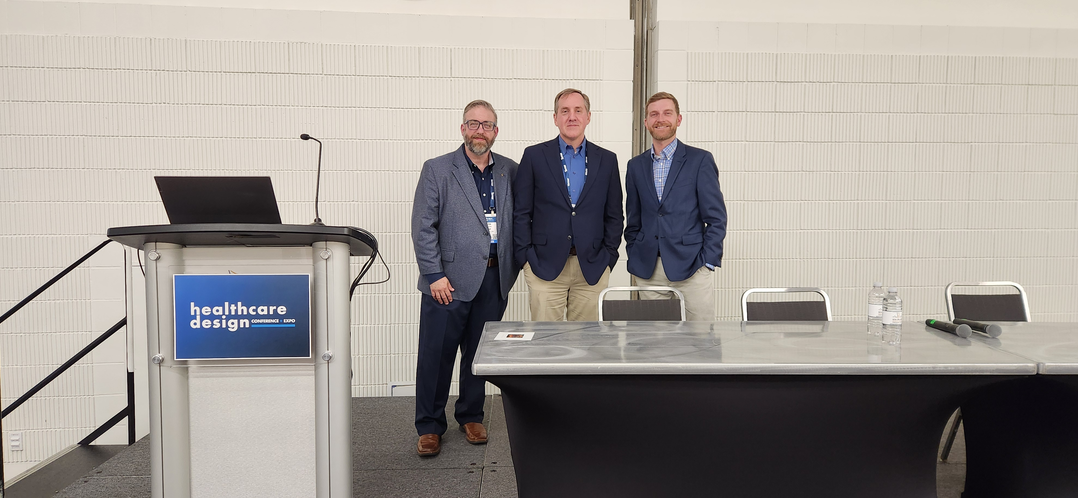
BHDP’s Dr. Justin Ferguson and Bryan Ruby presented with Bill Dillon, from UC Health, at the HCD Conference.
Matt Scott: The Heightened Role of the Healthcare Designer
Healthcare delivery is becoming more complex, with new models of care, evolving technologies, and shifting patient needs, reshaping how and where care happens. As architects and designers, we cannot simply design for the way healthcare operates today. We must anticipate what comes next and create environments that can accommodate different types of care, adapt to change, and support the people who rely on them.
This means looking beyond the immediate project requirements and asking bigger questions. How might care delivery evolve over the next five, ten, or twenty years? What flexibility can we build into our designs now to support those changes later? And how can the built environment become an active partner in improving healthcare rather than simply the setting in which it happens?
Key Takeaways: While the delivery of care continues to evolve, so does the role healthcare architects and designers. We have a responsibility to design for a changing future, a duty to understand financial and regulatory structures that shape care delivery, an onus to help our clients navigate the complexity of the healthcare built environment, and a commitment to continually test whether the environments we create are truly making a difference.
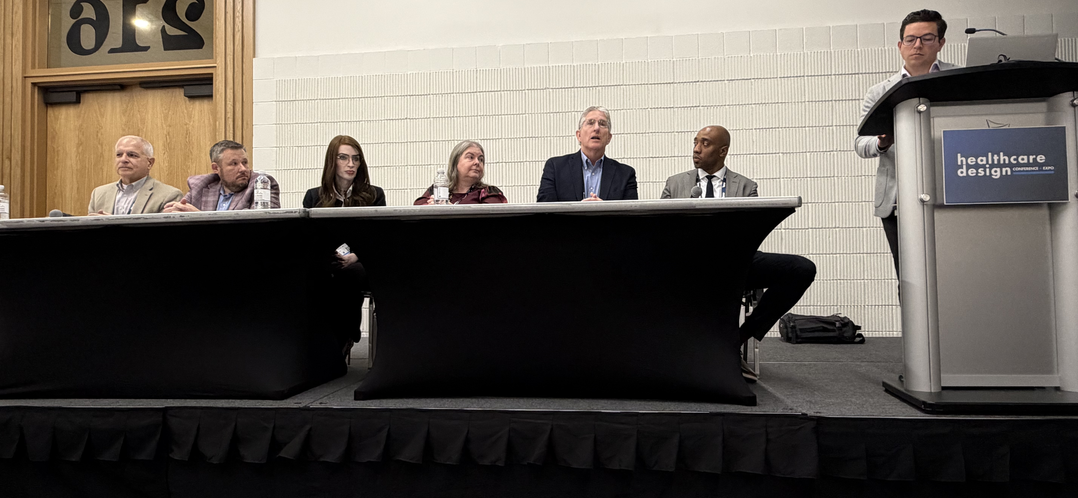
Matt Scott moderated an ACHA panel about the shifting policies in healthcare.
Until Next Time…
We look forward to seeing you at the next conference!
Can’t wait until then? Reach out to our team to share your key takeaways or to get more information about how we’re applying what we learn to our everyday work.
Author
Content Type
Date
November 05, 2026
Topic
Healthcare Design
Conferences

Mindy Graves, Healthcare Market Leader
Mindy Graves joins BHDP as the Healthcare Market Leader. She is a design professional and strategic thinker with a deep understanding of hospital operations and capital planning. She brings more than 30 years of national expertise in both design and construction. Mindy's core competencies include team leadership, design development, operations, and capital project management. She holds multiple certifications, including EDAC, NCIDQ, LEED AP, Certificate in Gerontology, and RE. She is passionate about creating and delivering high-quality, sustainable, and accessible spaces that enhance the health and well-being of patients, staff, and communities.

Bryan Ruby, Senior Architect
Bryan believes that healthcare design naturally lends itself to the inherent well-being of its communities. As an experienced Senior Architect on the Healthcare team, Bryan’s entire career has focused on healthcare architecture and acute care design, and he has been exposed to almost every project type within a hospital setting. In his practice, Bryan tends to take a classical approach to his designs and applies these timeless styles to modern ideas.

Dr. Justin Ferguson, Director of Applied Research
With three decades of researching, teaching, and practicing community-engaged and organizational design and planning, Dr. Justin Ferguson brings both immense knowledge and enthusiasm to creating strategic and transformative environments. As Director of Applied Research, Justin seeks to uncover the challenges clients face with their organizational spaces, works with design teams to develop predictive design decision-making, and ultimately measures the efficacy of BHDP’s work. His extensive portfolio spans various markets across the U.S., including collaborations with major clients like the GSA and Fifth Third Bank, making him a unique asset to BHDP.

Matt Scott, Client Leader
Matt Scott joins the BHDP team as a Client Leader on the Healthcare team. He has spent the last 11 years in the primary healthcare field, with a focus on pediatric healthcare design and planning. Matt is a Board-Certified Healthcare Architect through the American College of Healthcare Architects (ACHA). He believes healthcare design offers a unique opportunity to create environments that support care and healing, and that thoughtful design can foster well-being and improve health outcomes.