
Healthcare's Trust Problem: Why Patient Centered Design Matters for Vulnerable Patients
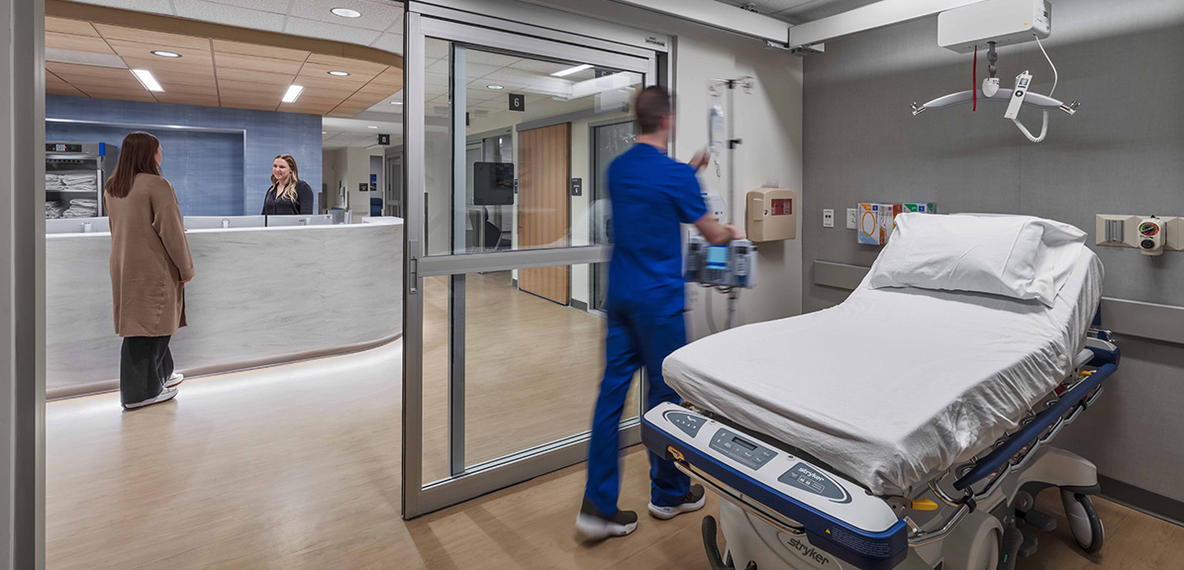
A patient walks into a healthcare space for the first time, about to be examined, treated, or given life-changing health information. They encounter lighting different than they remember from anywhere else. The hospital gown they’re given is unfamiliar. And someone they've never met is about to make a decision that affects their health.
Many healthcare facilities aren't built with this moment in mind. They're built around clinical workflow: equipment placement, staff travel distance, and bed counts per floor. Necessary work, but it leaves a gap. The built environment that runs efficiently for staff can still feel disorienting, even threatening, to the person it's meant to serve.
Considering the potentially vulnerable state of patients in these critical facilities is key to establishing better trust and eventual outcomes.
Key Takeaways
- Patients arrive in a vulnerable state.
- Patient-centered design returns small amounts of control: lighting, privacy, wayfinding.
- Comfort and trust are tied directly to reimbursement through the HCAHPS survey and Medicare in a hospital setting.
- Evidence-based design grounds these decisions in research and post-occupancy data instead of instinct.
- Real BHDP healthcare projects exemplifying patient-centered design include an urgent care clinic built around concierge-level trust and a dedicated breast care center.
Healthcare's Trust Problem
Patients don't arrive at a clinic in a neutral state. They arrive guarded. Often scared, often in pain, unsure what's about to happen to them. They're handing control of their body and time to strangers, in a typically unfamiliar building.
None of this is solely the fault of design. Clinical function must come first; a hospital that can't operate efficiently fails everyone. Reliability is the defining factor of trust. An inefficient or chaotic operation diminishes that trust. Healthcare design has historically treated efficiency and reliability as the same thing.
Single-Purpose Design Can Leave Patients in the Cold
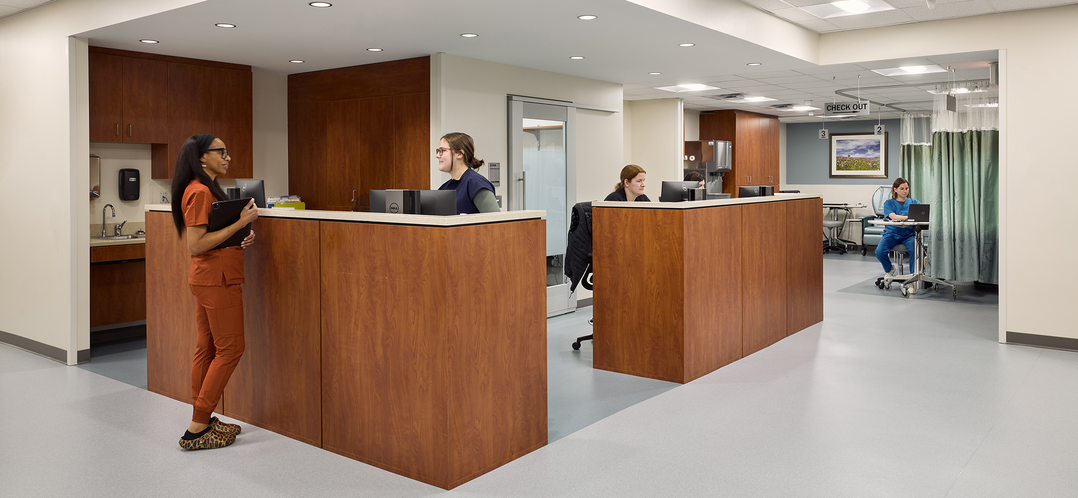
UNC Health Rex Neurosciences & Spine Center entrusted BHDP to create a new main entrance area, strategically designed to direct patients seamlessly to their intended destination. The design improves staff efficiency and creates a positive, streamlined, an
Trust, in a clinical setting, isn't about finishes or a dramatic lobby. It's whether the patient feels the space was built with them in mind, not just around them. That distinction shapes more than mood.
For that reason, spaces must support both the functional duty and the emotional response. A corridor must be optimized for clinical efficiency while being clearly defined for patient navigation. A waiting area must make the most of limited space while providing positive distraction. A registration desk must efficiently process patients while providing a warm welcome.
A patient who feels safe enough to ask questions, disclose symptoms honestly, and absorb what a doctor tells them is a patient whose health outcomes improve. Fear narrows attention. Anxiety about the surroundings eats into whatever bandwidth a person has left for processing their own diagnosis.
Even Built Space Requires a Relationship
There's a social version of this problem, too. Patients returning for ongoing treatment of chronic conditions, infusion therapy, dialysis, and physical rehab build a relationship with a space in the same way they'd build one with a person. If that relationship starts out cold and hard to navigate, it colors every visit that follows.
Patients want to know and understand the process they’re experiencing at a facility so they feel they’re making progress in their healthcare journey. If staff are properly operationalizing the environment, patients will be moved from the initial large waiting room to a sub-waiting area and then to the exam room. This continual progression culminating in a final treatment or exam gives the perception of shorter wait times, increasing patient satisfaction, and creating that sense of trust between patient and facility.
Urgent care and other non-regularly visited practices have their own challenges with trust. There's no long-term relationship to build on, no history with the space. The first impression becomes even more critical with repeated patient visits.
Patient-Centered Design as the Fix
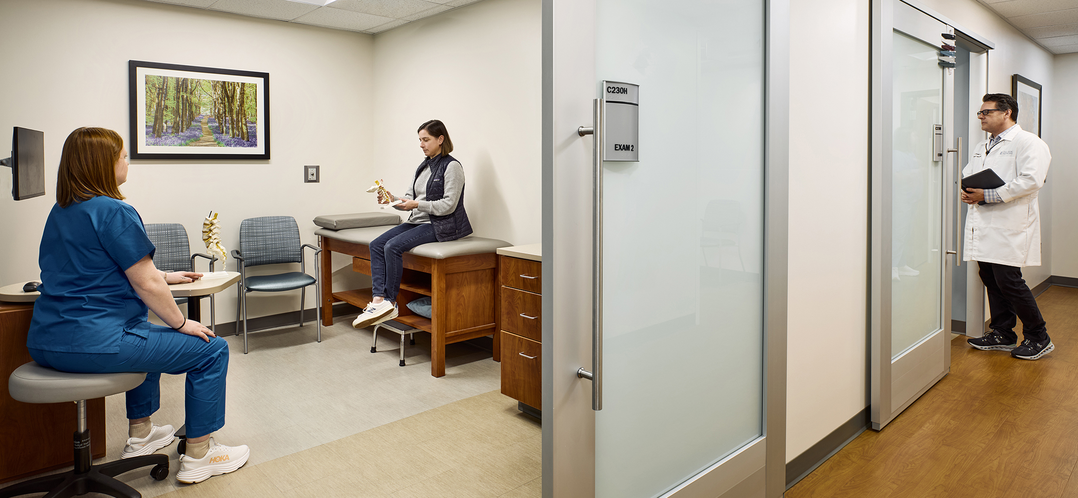
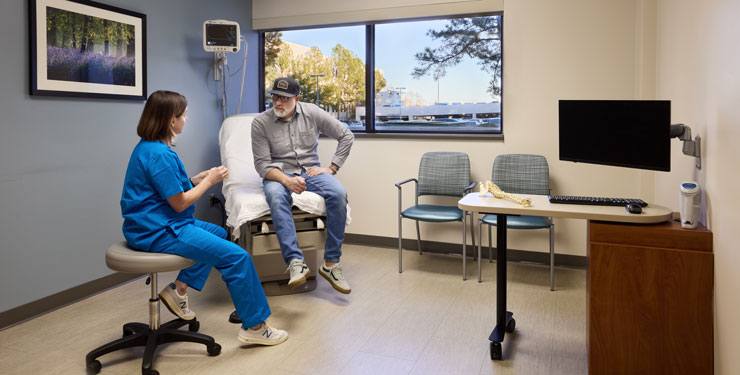
BHDP designed the UNC Rex Neurosurgery and Rehab Clinic to support both pre- and post-surgical consultations. It features several new exam rooms that provide more efficient, private spaces for patient care.
Patient-centered design starts from a simple premise: the person receiving care should shape the space. Simple to state, harder to practice, because the patient perspective is not always taken into consideration at a project’s outset.
In practice, it comes down to specific, unglamorous decisions:
- Can a patient control the lighting in their own room? Dimmable options for patients with light sensitivity, or color control for pediatric patients?
- Is there somewhere for patient family members to sit that keeps them engaged without being in the way?
- Are signage and wayfinding intuitive to someone who has never set foot in the building?
- Is transition space incorporated into the process of care for a family that just received hard news and isn't ready to walk back into a crowded corridor or waiting area?
Autonomy does more work here than it's usually given credit for. For example, in an in-patient setting, a patient who can dim their own lights or adjust their own blinds has regained a small measure of control in a situation largely defined by uncertainty and questions.
When designed correctly, these strategies don’t add construction costs. What they do require is attention, and a willingness to design for those at their most disoriented and vulnerable state.
This Isn't Just Values. It's Revenue.
In the healthcare facility setting, patient experience can often be tied to financial outcomes. Not that values don’t matter, but the bottom line is that a leader often plays a role in decision-making in these types of settings. Revenue can be impacted by the results of the Hospital Consumer Assessment of Healthcare Providers and Systems (HCAHPS) Survey, a standardized patient satisfaction survey used across U.S. hospitals.
Stronger scores earn higher reimbursement. Weaker scores cost money—at scale, that adds up fast. But only two of the survey's questions touch on the physical environment at all. The built space is underrepresented in the very metric that determines a facility's financial outcomes.
That reframes the question. It's not, "Should we invest in patient comfort?" It's, "We're already being measured on this, so why isn't design being treated as a lever?" Comfort stops being a soft extra once it's understood as baked into the reimbursement model. It's a requirement disguised as a courtesy.
There's another layer of consideration that doesn't show up as directly but matters just as much over time. Patients today have more choice than ever in where they seek care, especially for elective procedures, specialty clinics, and outpatient services.
A patient who feels dismissed or uncomfortable doesn't just report it on a survey. They tell friends. They leave reviews. They look elsewhere for care next time. Design that earns trust protects more than a reimbursement score. It protects the relationship between a health system and the community it serves.
What Patient-Centered Design Looks Like in Practice
Good intentions aren't enough on their own. Backing patient-centered design strategies with evidence-based design grounds these design decisions in credible research and measurable patient outcomes rather than instinct. Access to natural light, views of nature, acoustic control: these aren't decorative flourishes. Research studies and accumulated evidence have shown that these choices reduce patient stress, support faster recovery, and improve patient safety by lowering staff fatigue and medical errors – all of which contribute to building patient trust.
BHDP runs this as a continuous loop: define goals, gather evidence, test design concepts, build, measure results once real people are using the space, and then apply these findings to the next design. Those last two steps, however, are often skipped or omitted. Plenty of healthcare design is judged on polished renderings, rather than what happens after patients move through the finished rooms for six months. Post-occupancy evaluation is what closes that gap, and it's the difference between a design philosophy and a marketing slogan.
Case Study: A Clinic Built Around Trust as a Brand Strategy
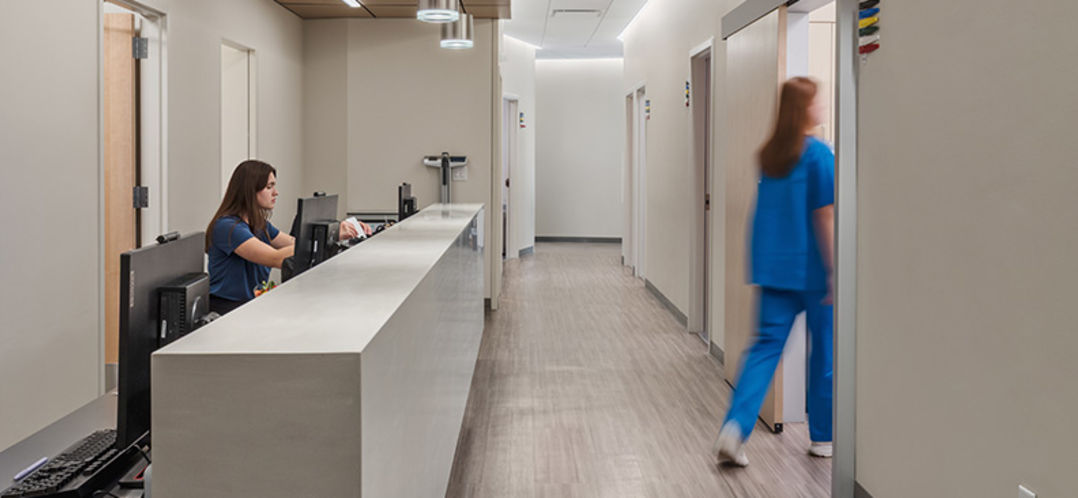
FastMed Urgent Care partnered with BHDP to design a clinic that broke the traditional urgent care mold to create a concierge experience so elevated and patient-focused that people would return to any FastMed location with confidence.
Urgent care sits in a strange spot for patients. It's not the emergency room or department, but it's rarely a planned visit either. People arrive worried and in pain, unsure if what's wrong with them is serious.
For FastMed Urgent Care's Raleigh-Harrington Clinic, BHDP treated that uncertainty as the design brief itself. The client's own goals named it directly: a concierge-level, patient-centric design built to elevate healthcare experiences and earn trust in the brand, not just move people through faster.
That showed up in details easy to miss and hard to overstate.
Corridors use linear lighting instead of overhead fixtures, a small choice that helps patients navigate the facility and provides an interesting design far from the typical institutional look of 2x2 or 2x4 recessed fixtures running down the hallway.
BHDP lowered the x-ray viewing window to suit shorter staff and caregivers. This is a practical fix that reduces barriers for staff while also ensuring eye contact and social cues can be maintained through the imaging procedure, ultimately reinforcing trust between staff and patients.
The design of registration, team stations, and overall layout enables patients to see a staff member from anywhere in the facility. This simple design strategy ensures patients always have easy access to someone who can assist them in their care process.
None of these decisions show up in a press release. Instead, these choices are seen – and felt – when a patient walks out of an urgent care feeling like they were actually treated, rather than just processed. That's the difference between a clinic that treats trust as marketing language and one that treats it as a design requirement.
Two Smaller Notes on the Same Idea
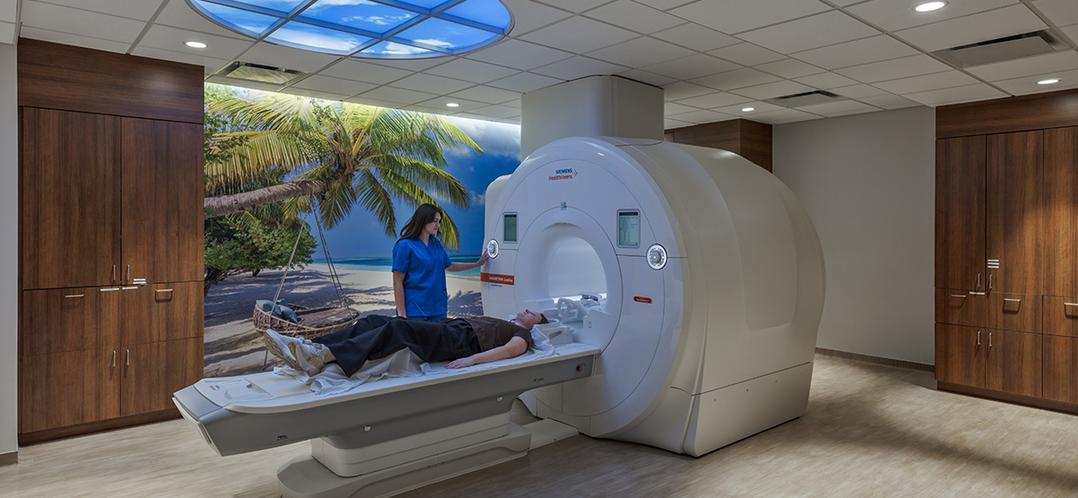
The Wake Radiology Panther Creek MRI suite delivers a welcoming environment where patients feel at ease and clinical staff can work with confidence.
Privacy and trust show up on a smaller scale, too. At Wake Radiology's Panther Creek MRI suite, a modest 1,036-SF footprint still made room for a calming skylight and warm finishes, proof that comfort-driven design isn't reserved for large-scale builds.
And the Cary Breast Care Center's individual dressing rooms attached to each mammography suite provide another type of safe space, particularly for patients in a vulnerable state.
Not every kind of vulnerability looks the same, and these two projects make that clear. An MRI patient needs calm during a claustrophobic, drawn-out scan. A breast care patient often needs discretion during a single, high-stakes visit. A design approach that treats every patient experience as the same problem with the same solution will miss both.
Patient-Centered Design Is the First Fix, Not the Last One
Design can't remove someone's fear before surgery, and it can't undo the fact that a diagnosis changes a life. What it can do is make the first few minutes in a space feel less like an ambush and more like an arrival. It can hand a scared patient a small amount of control back. It can make a nurse's shift less exhausting, directly influencing the quality of patient care and overall care delivery.
Trust and vulnerability aren’t merely decoration layered over efficiency. It’s structural to both the mission and the margin. Get the trust right, and the patient and staff satisfaction follow. Get it wrong, and no amount of clinical excellence can fully make up for a patient who leaves a facility in a more scared state than when they arrived.
Design Healthcare Spaces That Earn Trust from the First Step In
If your facility is weighing how patient trust factors into its next project, BHDP can help translate that priority into a design process grounded in research and measurable outcomes.
Contact BHDP to discuss patient-centered design for your next healthcare project.
Author
Content Type
Date
September 22, 2026
Market
Practice
Topic
Patient Experience
Healthcare Design

Mindy Graves, Healthcare Market Leader
Mindy Graves joins BHDP as the Healthcare Market Leader. She is a design professional and strategic thinker with a deep understanding of hospital operations and capital planning. She brings more than 30 years of national expertise in both design and construction. Mindy's core competencies include team leadership, design development, operations, and capital project management. She holds multiple certifications, including EDAC, NCIDQ, LEED AP, Certificate in Gerontology, and RE. She is passionate about creating and delivering high-quality, sustainable, and accessible spaces that enhance the health and well-being of patients, staff, and communities.