
Revitalizing Campus Housing to Boost Recruitment and Retention
First impressions are essential, particularly when it comes to a place to call home. For students embarking on their collegiate journey, their prospective residence hall influences their opinion of life on campus. They envision themselves studying and living there – and then compare it to their options elsewhere.
With many campuses still relying on student housing constructed between the 1950s and 1990s, today’s students quickly notice the gap between older halls and more modern student accommodations they see online, during in-person campus tours, or during visits with friends at other campuses. This contrast has become sharper and more pronounced in recent years and is increasingly impacting results in student retention and recruitment.
Student Housing as a Competitive Factor in Retention
When campus leaders discuss ways to improve student retention, especially in that critical transition from the first to second year, the conversation typically starts with academics or advising. But increasingly, housing is a key factor in collegiate decision-making. It’s logical; this is the place where students will spend a great deal of their extracurricular time sleeping, relaxing, and socializing.
During a recent CFO roundtable, one leader shared that students had transferred because campus housing felt dated compared to peer institutions. This sentiment is echoed across multiple campuses, especially smaller colleges trying to keep pace with larger (and sometimes publicly funded) universities’ amenities.
When students tour a hall and see a space that feels overlooked, it raises a pertinent question: “If this is where I’m expected to live, what does that say about the rest of the campus experience?” It’s a quiet, emotional reaction, one that shapes decisions long before classes begin.
Student Housing Impacts Social and Academic Success
Students today expect privacy, comfort, and convenience from their campus housing. Air conditioning has not been viewed as “optional” for some time, and reliable Wi-Fi is considered the baseline for residence life. Communal areas, like study lounges, shared kitchens, and casual hangout spaces, go a long way toward creating a positive perception among students – while also aiding their personal development in ways that extend beyond pure academics.
According to BHDP’s research on incoming Gen Alpha college students, we anticipate they will spend more time engaged in residence and student life activities when compared to previous generations. This emphasizes the need for institutions to invest in the quality of their residence halls, improved dining experiences, inviting communal spaces, and other environments that will support holistic personal growth.
Our research also anticipates that this generation will be typified by the concept of being “together alone”. We believe they will favor small group interactions while engaging in larger social behaviors and spaces. Design implications include creating semi-enclosed spaces along the edges of large gathering areas within residence hall lounges, student unions or learning commons, which have more recently been planned as “wide open”. We anticipate these opportunities for more secure and intimate collaboration and social interaction being both appealing and important to Gen Alpha.
These requests aren’t about a sense of entitlement or expectation of luxury. They are merely practical needs for modern-day students who balance their academic pursuits with social lives, part-time jobs, and constant digital connectivity.
When Housing Becomes a Reason to Transfer
Campus leaders increasingly hear variations of the same story: A student arrives excited, settles into an older hall, and quickly realizes the living environment affects everything from mood to study habits.
Students who feel disconnected or uncomfortable in their living space are far more likely to leave. Colleges that invest in refreshing rooms and strategically placed communal spaces often see steady improvements in both student outcomes and retention, especially during that critical transition from the first to second year.
Based on client experience and diligent research, housing isn’t the sole reason students stay, but it’s often the first reason they drift away.
Smart Strategies for Modernizing Student Housing
Contrary to popular belief, modernizing student housing doesn’t always require a sweeping rebuild. The most realistic projects often layer together upgrades, reconfigurations, and targeted new construction, each scaled to budget and campus culture.
Renovate and Refresh
Small improvements can create noticeable change. The “quick win” involves refreshing finishes, improving lighting, and adding branding that reflects campus identity. These projects help older halls quickly flip from a recruitment and retention liability to a lively and effective asset.
Common areas deserve an elevated level of attention. Consideration should be given to eliminating a room (or two), in the interest of adding space for students to socially connect and collaborate. Whether it is a lounge, study nook or shared kitchenette, these spaces are critical. HVAC improvements may not be seen, but they are felt through improved sleep and indoor air quality. Refreshed bathrooms can flip perception and raise satisfaction levels almost overnight.
While these changes may sound simple, they directly support the goal of improving student retention by giving students a more comfortable home base.
Heidelberg University’s Miller Hall
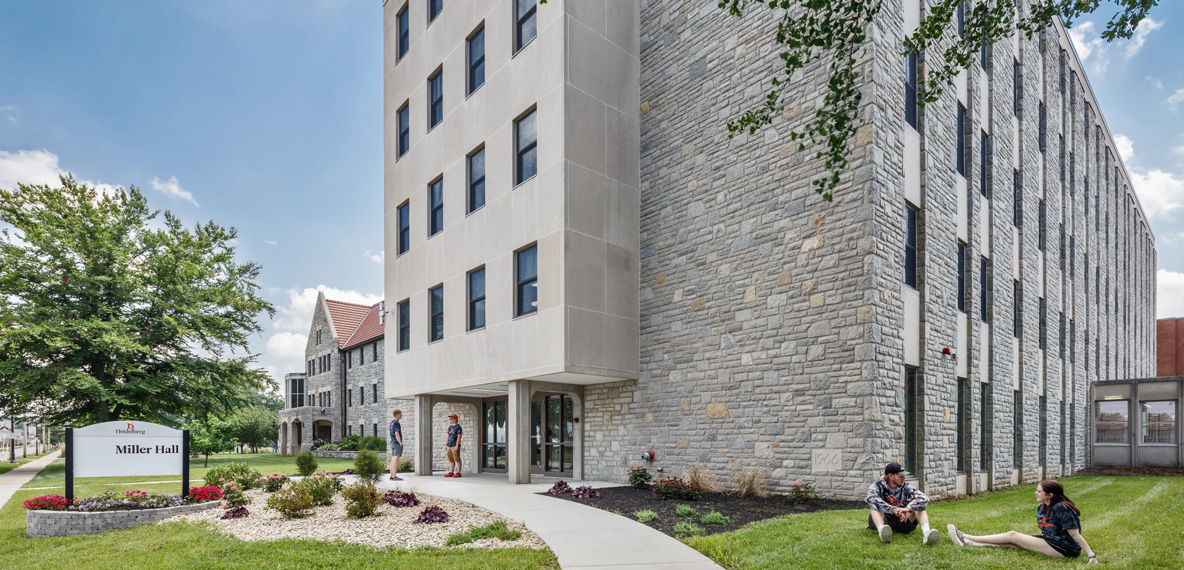
This BHDP residence hall project embodies the ‘renovate and refresh’ approach to modernizing student housing. Miller Hall is the largest residence hall on the Heidelberg campus. BHDP completed a comprehensive study on how to improve the student experience and then applied our findings in a phased renovation of the building.
BHDP renovated Miller Hall’s first floor to create social space and improve circulation with the adjacent dining hall. The expanded first-floor lounge features a pool table, reading room, and several other opportunities for students to gather. Each floor received suite renovations, new group study rooms, updated kitchen areas, and additional places to collaborate and socialize.
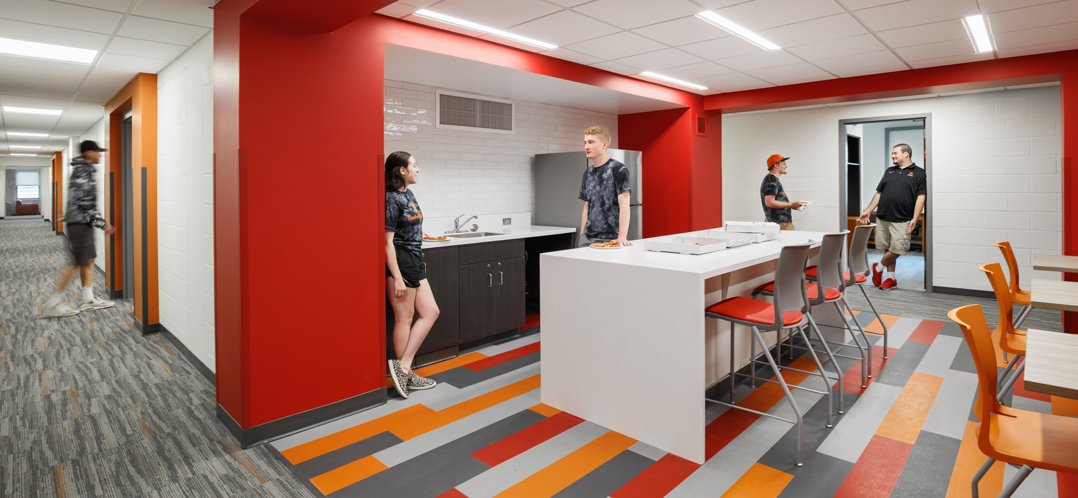
Miller Hall at Heidelberg University was renovated to create more opportunities for students to commune with one another, such as this shared kitchen space.
Reconfigure for Flexibility and Choice
Older halls often feature a singular room style, which is frequently an abundance of modestly sized doubles lining a double-loaded corridor. Today’s students expect options: doubles, singles, suite-style rooms, and mixed bathroom styles. Reconfiguring rooms helps colleges add variety to their housing options without constructing an entirely new building.
Reconfiguration also supports a more varied approach to student housing design, enabling colleges to appeal to different student personalities while still maintaining a cohesive residence life vision.
Right-Sized New Construction
Sometimes the best solution is a new residence hall built with clear priorities: wellness, community, and flexibility.
Modern student housing design often includes:
- Shared kitchens with ample space for group cooking
- Study zones of various sizes, including individual pods
- Game rooms or media lounges
- Outdoor seating, green areas, or recreation access
- Thoughtful interior design and branding that reflects the institution's unique culture
These spaces support social connection and academic focus. They also reinforce a strong sense of campus identity. Graphics, colors, or experiential elements can turn a new hall into a welcoming anchor point for student life.
Cedarville University's New Residence Hall
This 2024 BHDP residence hall project took the ‘right-sized new construction’ approach to creating a new residence hall. Cedarville University sought to expand its on-campus housing to meet the needs of its growing student population. The strategic plan envisioned a vibrant, community-focused residential district, with approximately 1,500 new beds, enhanced amenities, and stronger connections to existing campus facilities.
BHDP developed a residence life master plan calling for four new residence halls arranged around a central quad. The first hall featured dual-occupancy rooms and community-style bathrooms. The building was designed to promote interaction and academic success, and featured central social lounges, dedicated study areas, shared laundry, and more.
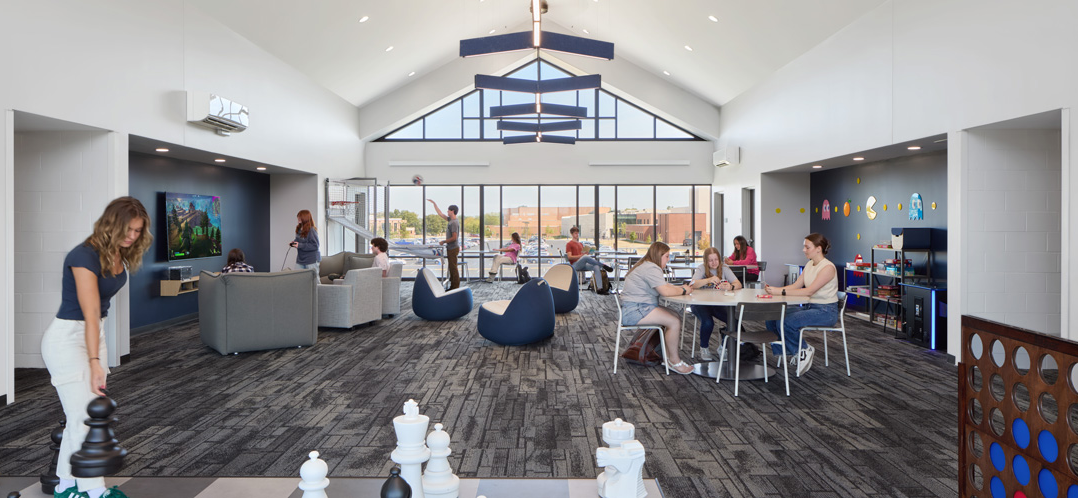
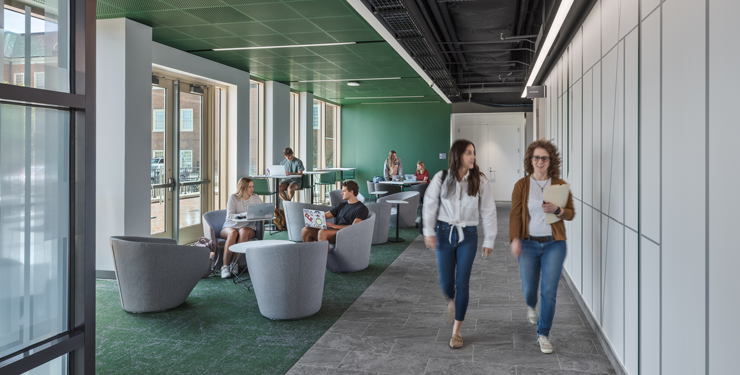
A social lounge in Cedarville University’s newly constructed residence hall fosters a cohesive community and sense of social connection for students.
The Measurable Impact of Better Housing
The connection between housing and retention is no longer as abstract as it once may have been. Colleges now track it closely, often finding that improved residence halls become a key stop during admissions tours and help prospective students feel grounded once they arrive.
What the Data Says About Retention
Students who feel comfortable and supported where they live tend to form friendships more easily, get involved in campus life sooner, and manage stress more effectively. These behaviors, as they relate to campus residency overall, directly influence retention. Research from the University of Wisconsin-Madison supports this claim:
“The finding that campus residents experience a 3.3 percentage point increase in their probability of persisting into their second year provides causal support for the notion that campus residency improves retention.”
Student engagement, through a variety of methods, is crucial for a positive academic and residential student experience (and potential retention). According to research from the Association of University Directors of Estates and the Higher Education Design Quality Forum:
… ‘academic performance does not result from living on campus in and of itself, but through the opportunities to engage with campus life and levels of support on-campus residential communities can provide’...
Retention teams often ask how to improve student retention in higher education without stretching budgets. Increasingly, the answer lies in housing, as small environmental improvements continually pay off.
Learning from the Students
When campus housing projects respond to the expectations of the incoming student body, success and satisfaction are attainable. According to the 2025 State of the Student Housing Industry Report:
“inclusive programs, Living Learning Communities (LLCs), and mental health-responsive housing directly correlate with higher resident satisfaction and retention. Institutions that invest in holistic, student-first experiences are seeing results.”
Indeed, the survey further notes three leading factors that influence resident satisfaction, and they’re in direct support of our proposed opportunities for renovating and refreshing existing spaces:
- Room conditions and furnishings
- Sense of community
- Amenities
These results support what many administrators already suspect: student housing plays a larger role in daily life than most metrics capture. When housing (residence life) improves, student life and academic life improve as well, and retention increases.
Housing is a Strategic Lever
Many colleges believe they need a major capital investment to make meaningful change. In reality, small and strategic updates help campuses strengthen recruitment and retention while buying time to acquire funding for larger projects.
Scalable Solutions for Every Budget
Renovations can begin with finishes, community spaces, or lighting upgrades. Updated layouts and reconfigurations can reshape residence life without major construction. Thoughtfully designed new halls add needed capacity while visually expressing campus culture.
Some institutions need to phase their housing projects. This often occurs when there is a lack of ‘swing housing’ to accommodate students who reside in halls where construction is planned. A residence hall might shift one wing to suites for upperclassmen, convert another to smaller single rooms for first-years who prefer privacy, and incorporate social amenity spaces to combat isolation. Adding or improving living–learning spaces supports academic goals and strengthens the community. These projects can be phased wing by wing, allowing campuses to manage cost and occupancy more smoothly.
Another commonly used approach when an institution cannot operate without losing beds for a six or 12-month period is floor-by-floor renovations. Construction takes place in consecutive summers over the course of a few years. This timely approach allows colleges to complete their renovation projects without disrupting student life or needing to rely on swing housing to accommodate displaced students. Whether improving comfort, privacy, or community areas, each step helps colleges show students they matter; a message that resonates strongly when students decide where to stay and where to return.
Design that Reflects Student Culture and Values
Housing should connect with students’ academic life, social habits, and personal routines. Thoughtful student housing interior design turns residence halls into places where students feel grounded, supported, and included.
Aligning higher education design with student expectations also supports the broader goals of retention and satisfaction. It helps campuses feel current, adaptable, and welcoming, and when strategically planned, can be done at any level and scope.
BHDP as a Trusted Partner in Student Housing Transformation
BHDP’s work across campuses, including renovations, reconfigurations, and right-sized new halls, offers a practical roadmap for colleges wondering how to modernize without losing financial balance.
Our experience in university residence hall design and modern student housing gives institutions confidence that every project, large or small, will support the behaviors that matter most: connection, well-being, and (above all) academic success.
If you want support designing student housing that truly reflects how students live and learn today, complete the form below and our team will contact you.
Author
Content Type
Date
June 09, 2026
Market
Topic
Campus Planning

Derick Stadge, Higher Education Market Leader
With over 20 years in design and construction, Derick is passionate about turning ideas into meaningful built environments that leave a lasting impact on campuses, communities, and cities. His expertise spans design and planning, sustainable strategies, project management, construction administration, and client leadership. Derick has led a wide range of higher education projects—from labs and classrooms to residence halls and public spaces—managing varying scales, budgets, and complexities. His background working within a major university’s planning and design team gives him a unique perspective on strategic and capital planning, the design process, leadership, risk management, and the value of effective collaboration.