
What To Build Next (And Why): Strategic Capital Planning For Enrollment Yield
Higher education leaders are at a critical moment. Declining enrollment and rising operating costs mean that every major decision must support student success while also protecting the institution’s financial sustainability. Families are also evaluating colleges and universities with sharper scrutiny than in the past. With a lower birth rate in the United States than ever before and changes in administration, institutions are increasingly competing for students.
In that environment, capital projects can’t be treated as routine infrastructure upgrades. They serve as strategic levers that can influence enrollment, support retention, and shape how students experience campus. Our research team used multiple evidence streams—student priorities, enrollment patterns, and project outcomes—to help leaders approach strategic capital planning with clearer expectations around return and impact.

Why Capital Planning Has Become an Enrollment Yield Strategy
Capital investments are often discussed in terms of facilities need, deferred maintenance, or space shortages. But our research findings frame student-facing projects as decisions that can support recruitment and retention when they align with what students value and what the institution is trying to achieve.
BHDP analyzed a dataset of higher education projects from multiple design and construction companies across the country and paired that with a survey of high school seniors, plus a leadership roundtable. The goal was to provide actionable strategies for capital planning to improve enrollment yield, grounded in both quantitative ROI metrics and the lived priorities of prospective students.
Research Sources for the Full Picture
The white paper combines three complementary sources:
- A student survey (qualitative research)
- A multi-year capital project dataset (quantitative research)
- A leadership roundtable to interpret the patterns
The survey explored the relationships among factors that influence college decisions, finding meaningful patterns aligned with broader research on how students make decisions. BHDP also reviewed 229 student-facing higher education capital projects built between 2017 and 2025, categorizing them into research, student life, academic, residence/dining, and athletics. This review found the enrollment impact of capital projects often compounds.
Finally, the roundtable BHDP convened brought together leaders from a diverse array of institutions to discuss campus investment decisions. Once again, this conversation also connected research findings to broader strategic decisions about recruitment and retention.
Student Decision Drivers: Insights From the Class Of 2025
The Class of 2025 survey results make a clear point: affordability is the top priority for students, with academics and campus life close behind. These findings help explain why some projects may support recruitment more directly, while others matter more for retention and student satisfaction.
- Affordability: A top decision driver, 79% of students ranked cost as their most important factor. Offering competitive aid packages is essential for institutions, and helpful tools for recruitment/yield management include early aid estimates, tuition lock programs, and online net price calculators.
- Academic Programs and Reputation: 70% of students rate these as priority factors, and respond favorably to evidence of outcomes, including licensure pass rates, graduate school placement, and career-readiness statistics.
- Campus Life: Campus life and location were valued by 61% of respondents. Students connect wellness services, clubs, and vibrant gathering spaces with belonging.
- Campus Visits: Students who visited the campus they ultimately chose were twice as likely to enroll. Campus tours should be immersive, personalized, and curated to highlight affordability, community, and program outcomes.
- Campus Aesthetics: Aesthetics influence perceptions of institutional identity and quality. These investments should be functional and strategic, reinforcing affordability and academic narratives.
Strategic Implications for Leaders
The white paper’s quantitative analysis shows strong contrasts across facility categories. In general:
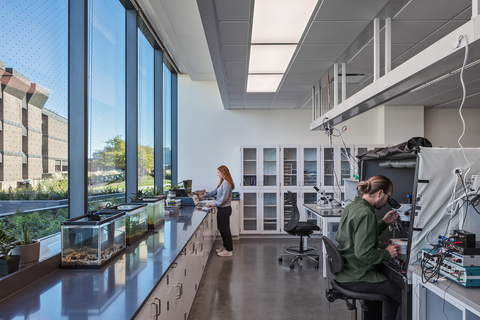
Research and student life facilities show consistently positive enrollment ROI patterns
• Academic facilities show modest but consistent results
• Residence and dining tend to correlate negatively with enrollment growth (suggesting their value is more retention-focused than recruitment-focused)
Taken into consideration together, the student survey data, construction ROI analysis, and leadership roundtable discussions have several strategic implications for higher education leaders.
1. Research and Student Life Should Be Prioritized
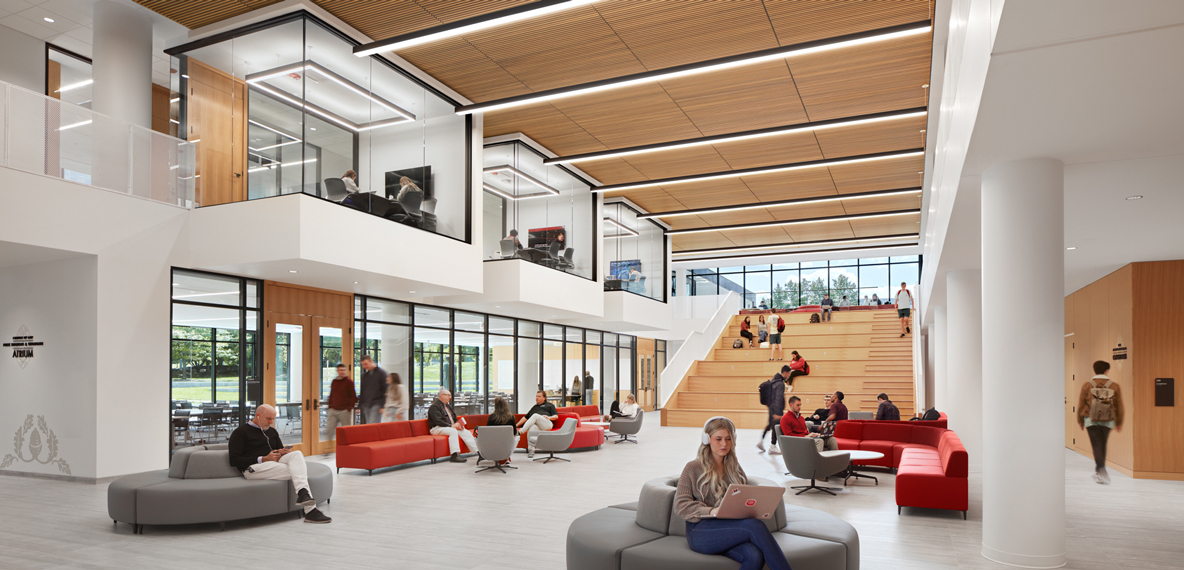
Research and student life facilities show the strongest and most consistent enrollment gains, with strong per-square-foot efficiency. Institutions investing in research may already have growth momentum, meaning growth can both enable and result from these investments. Student life facilities projects resonate because they shape community, wellness, and belonging.
Beyond measured returns, these investments communicate innovation, community, and future-readiness—qualities that influence how students and families perceive value.
2. Academic Investments Require Demand Alignment
Academic facilities remain central to institutional advancement but returns depend on alignment with program demand. The white paper stresses prioritizing projects that strengthen employability, licensure performance, and graduate/professional placement in high-demand fields.
Though they may drive slower change, these investments can be reliable, with value tied to credibility and reputation.
3. Residence and Dining Still Matter—As Retention Tools
Residence and dining projects should not be overlooked, even if they are not primary enrollment drivers. Their impact on satisfaction and persistence makes them key retention tools—helping institutions protect students they have already recruited.
4. Project Scale Should Be Approached Strategically
Smaller projects can deliver efficient, lower-risk gains. Larger projects can be transformative but require careful justification and alignment with repositioning or market expansion.
5. Athletics Should Not Be Treated as a Primary Yield Driver
Athletics can matter for some institutions, but it is not a reliable enrollment driver across the dataset. They ranked at the bottom in measurable enrollment ROI in the dataset, and depend heavily on the institution. Investments should be pursued strategically with clarity on where their value is expected (community impact, branding, donors), rather than assuming consistent yield gains.
6. Affordability And Transparency Must Be Foundational
Students are not swayed by facilities alone. They want to understand how facilities connect to outcomes and affordability. Even aesthetic improvements should tie to functional goals, while research facilities should be communicated as investments in student opportunities and financial stewardship.
7. Strategic Plan and Master Plan Alignment
Strategic and master plans should work together to guide capital investment. Plans help institutions stay mission-aligned, avoid reactive donor-driven projects, and drive unified growth. Leaders also caution that debt should be used carefully and aligned to strategic and master planning so it advances the mission without reducing future flexibility.
BHDP Can Help You Align Capital Planning With Enrollment Yield:
Capital planning is a strategic driver of enrollment yield, retention, and long-term institutional strength. If your next capital project is meant to improve enrollment, but you’re not sure whether it will actually move the needle—or how to explain its value to your stakeholders—you’re not alone.
BHDP brings research-backed insight and deep higher education planning experience to connect student priorities with facility ROI patterns, so capital decisions support recruitment, retention, and long-term institutional strength.
Reach out to BHDP to turn your next capital decision into a clearer, more confident enrollment yield strategy.
Author
Content Type
Date
April 07, 2026
Market
Practice
Topic
Campus Planning

Alejandro J. Medina, Client Leader
With over 16 years of experience, Alejandro J. "AJ" Medina works closely with his clients to understand their vision and values, identify strategic goals, and translate this understanding into the design of physical space that promotes the vision, values, and specific project goals. He builds strong relationships with his clients and successfully coordinates the efforts of architects, engineers, and key client stakeholders. AJ’s experience includes visioning, programming, and design for new construction and renovation projects, including student life, collaborative learning environments, health sciences education, athletics, residence life, and research and teaching laboratories.