
What Does the Future of Experiential Graphic Design Look Like in a Workplace Without Walls?
For the past several years, the "future of work" has been a moving target. What began as a temporary response to a global pandemic has become a lasting shift in how organizations think about the workplace. Hybrid work is no longer an experiment, and the office is no longer the primary setting for productivity.
Instead, employees expect a range of work environments, hospitality-inspired amenities, and experiences tailored to individual needs rather than standardized efficiency. Technology has made this possible, allowing work to happen almost anywhere. Yet even as the workplace evolves, one thing remains true: people still crave connection, inspiration, and a sense of belonging.
When designing workplaces at BHDP, Experiential Graphic Design (EGD) continues to play an essential role in shaping these experiences, creating environments that reinforce culture, communicate purpose, and foster engagement whenever employees choose to come together.
Changing Use Patterns Means Changing Storytelling Platforms
Architects and interior designers have responded to this new reality by reimagining the office around changing patterns of use. Fewer people occupy the workplace on any given day, but those who do expect more than a desk. They seek collaborative spaces, social hubs, wellness amenities, and environments that justify the commute.
Experiential graphic designers face a similar challenge. We can no longer assume business as usual or rely on the built office as the default platform for storytelling. Using Ray Oldenburg's familiar framework of first places (home), second places (work), and third places (community gathering spaces), it's worth asking not only where work itself is happening, but where organizational culture is happening.
Graphics Rely on A Physical Environment
Imagine an extreme scenario where the second place disappears entirely. Whether or not you believe work can be just as productive from home or neighborhood cafés, something undeniably changes when employees are no longer immersed in a thoughtfully designed workplace. Beyond potential losses in collaboration, mentorship, morale, or spontaneous interaction, there is another, often overlooked consequence: the absence of a carefully curated experiential graphics program.
For years, designers have extolled the virtues of using the workplace as a conduit for conveying key messages to occupants and creating a holistically branded environment. Pin-mounted mission statements on main walls. A mural in the common space depicting elements of the firm’s history. A timeline of firm milestones in the front lobby. The many nooks and crannies of the workplace allow for the emphasis and reinforcement of the values of the company it houses.
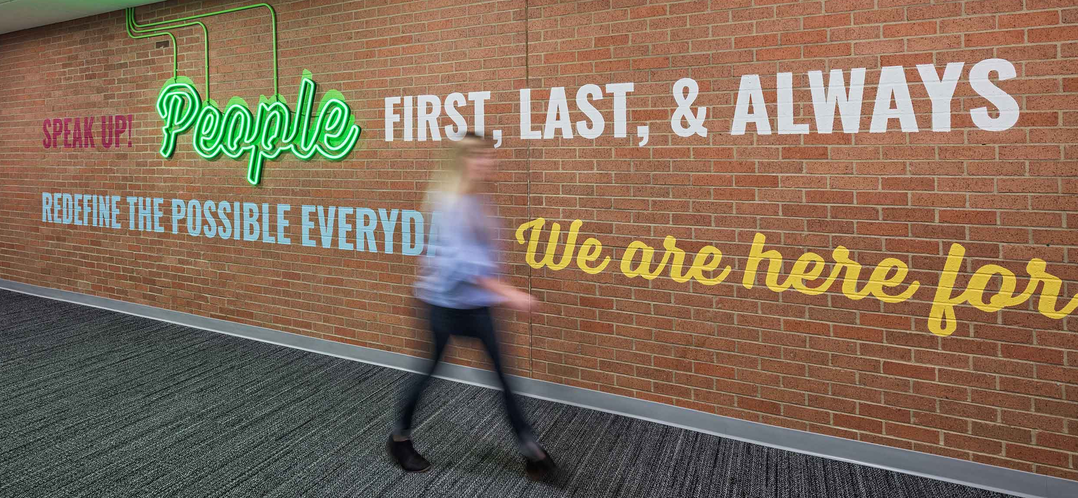
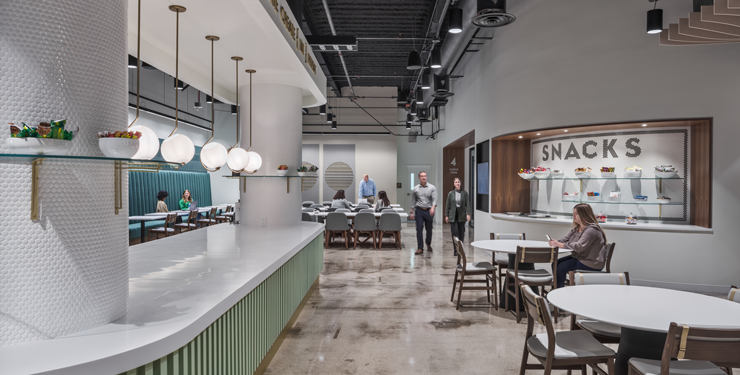
Ensemble Health Partners partnered with BHDP to create a comprehensive workplace design that celebrates and honors employees, shaping culture and encouraging collaboration with motivating and inspiring experiential graphic design.
Environmental graphics amplify organizational values, celebrate achievements, reinforce mission, and create a shared sense of identity. Without the physical environment to reinforce these messages, their influence becomes fragmented. The challenge for our profession is not simply preserving graphics; it is preserving the experiences those graphics create.
How Experiential Graphic Design Transforms Communal Spaces
When these old-standby showcase spaces start to disappear, instead of losing ground on the branding front, a door to entirely new opportunities opens. The question for designers becomes, “Can mission-oriented messages feel at home outside the second space?” Rather than limiting organizational storytelling to the office, experiential graphics can extend into other places where people naturally gather. Third spaces[LS1.1][LS1.2][LS1.3] can become concentrated touchpoints for culture and brand expression.
Examples can include:
- Cafes
- Community hubs
- Hospitality venues
- Dedicated customer and employee experience centers
But third spaces are evolving and continually being enhanced. The blurring of lines distinguishing spaces from one another altogether is increasing; indeed, it’s what many have in mind when it comes to the future of the office. The next several years will see the emergence of this enhanced space that transcends traditional definitions of first, second, or third, and create its own set of rules and standards.
Case Study: CareSource Social Hub, Designed for Changing Needs
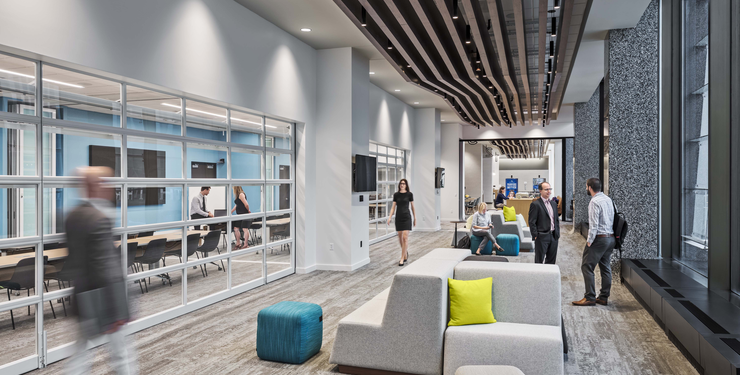
CareSource, a national health insurance company, engaged BHDP to rejuvenate its Dayton, OH headquarters with a dynamic, multipurpose work environment. The goal was to support new ways of working and create a sense of community within the workplace. BHDP’s design focused on transforming the second floor into a vibrant amenity hub, called the Social Hub.
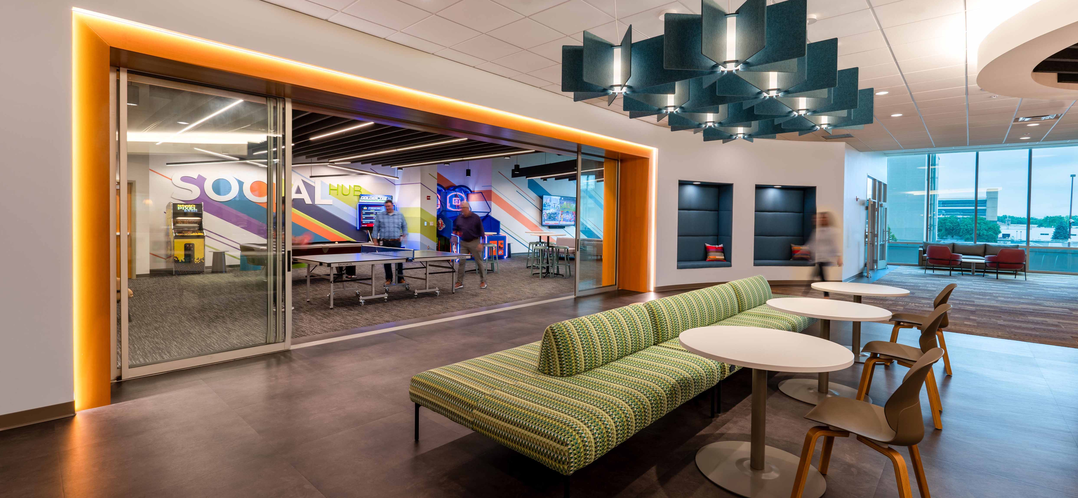
CareSource enlisted BHDP to rejuvenate its headquarters in Dayton, OH, to support new ways of working and foster a sense of community within the workplace. BHDP’s design focused on transforming the second floor into a vibrant amenity hub.
The Social Hub joined other third spaces housed in the second space: the Heartbeat Café, The Greenhouse, and a fitness center. The continued melding of these spaces within the workplace itself highlights the blurring of lines between them. The silos of work, home, and play are being deconstructed.
The new configuration is freed from established definitions and protocols and allows for a holistic embodiment of work today.
Finding the Future of Work in the Fourth Space
Beyond that, designers can begin thinking about emerging "fourth spaces":
- Temporary physical installations
- Pop-up activations
- Digital experiences
- Location-specific interventions
Each of these environments delivers highly targeted, timely messages, each demanding a different voice. Messaging becomes more contextual, more personal, and often more ephemeral, but it can also become more memorable because it meets people where they already are.
While the future of the workplace is certainly in flux, it is no longer just a binary conversation – should offices exist or not? – but rather, a conversation around rebalancing. The office will persist in a reduced but increasingly intentional role. Employees may visit less frequently, making every interaction with the environment more meaningful.
Offices will continue to be important destinations for clients, partners, and prospective employees as much as for the workforce itself. In that future, experiential graphics become even more important. With fewer opportunities to communicate culture organically, the built environment must convey purpose more quickly, more clearly, and more memorably than ever before.
The Evolution of Experiential Graphic Design Is Here
As the workplace continues to evolve, the role of the experiential graphic designer evolves with it. Responsibility has never been limited to creating signs or decorating walls. At its core, experiential graphic design is about visual communication that shapes human experience.
The media will continue to change—from permanent architectural installations to temporary activations, digital platforms, and hybrid environments—but the objective remains remarkably consistent: helping people feel connected to something larger than themselves. Whether that experience happens inside a headquarters, a neighborhood café, a branded experience center, or a digital space yet to be imagined, experiential graphic designers will continue to create meaningful moments that inspire, motivate, and foster belonging.
The workplace may become less visible, but the experience we design does not have to.
Adapting to the Future With BHDP
If your workplace is evolving but your brand messaging hasn’t kept up with the pace of change, BHDP can help. From corporate clients to industrial conglomerates to higher education facilities, we employ best practices in the world of experiential graphic design to share your story, how you want it, where you want it, in the best way possible.
Reach out to BHDP today to start the conversation around adapting to and for the future of the workplace.
Author
Content Type
Date
September 16, 2026
Market
Practice
Topic
Workplace Strategy
Design Thinking

Margaret Lange, Design Leader
Margaret leads BHDP’s Experiential Graphic Design team, overseeing strategy, execution, and integration across all markets. With a deep passion for connecting graphics and the built environment, she ensures that every project aligns with client goals and creates meaningful user experiences. Margaret has played a key role in delivering impactful solutions for clients such as The Procter & Gamble Company, Fidelity Investments, and Galen College of Nursing. Her portfolio spans projects across the United States, Canada, and Central and South America, reflecting both her global perspective and commitment to excellence.