
From Plant to Platform Part 3: What the IAMC Fall Forum Reveals About Trust and Industrial Resilience
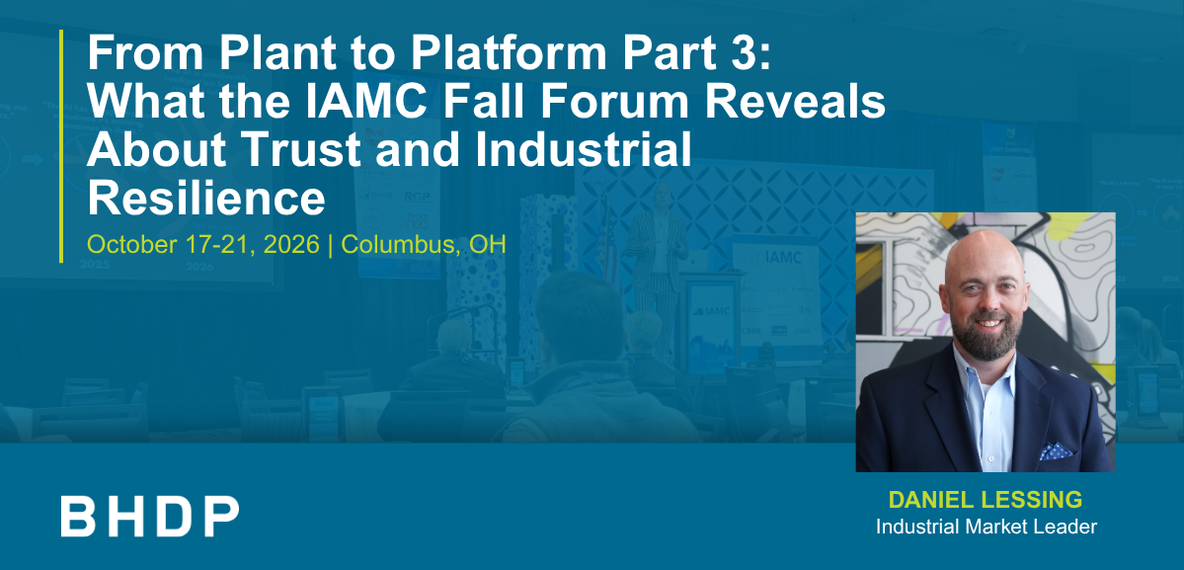
The IAMC Fall Forum in Columbus reinforced a growing challenge for industrial real estate: aligning infrastructure, workforce, and capital decisions with the pace of operational change. The discussions also highlighted the leadership and trust required to turn those decisions into results.
Across sessions on industrial markets, technology, resilience, and human performance, a common thread emerged. A facility’s ability to adapt depends on how well an organization understands its business, involves its people, and acts on changing conditions.
For owners, that brings strategic design further upstream. Before defining a building project, we need to understand the operational problem, test the assumptions behind the investment, and establish what success should look like over time.
Resilience begins before a site is selected
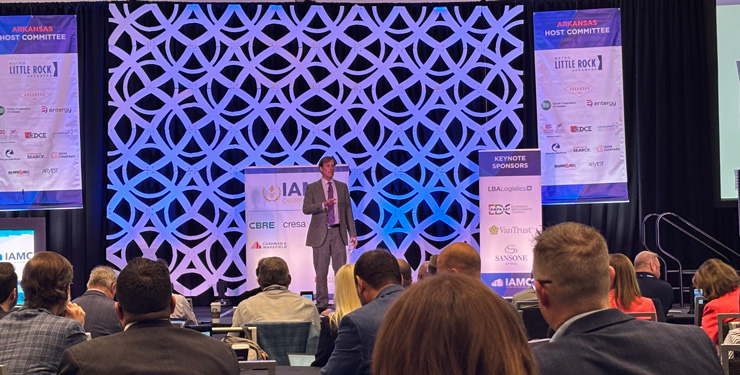
CBRE’s John Morris connected industrial real estate decisions to the changing economics of supply chains. His discussion of transportation costs, rail connectivity, and insourcing reinforced how closely a location decision is tied to the way a business sources materials and serves its customers.
In the breakout session, “Designing for Resilience,” Brian Corde, managing partner at Atlas Insight, linked industrial operations, workplace strategy, and site selection. His framework organized resilience around five factors: climate and physical risk, power, labor, supply chains, and the political environment. Together, they influence whether a facility can support the business through disruption.
An illustrative site selection comparison made the shift tangible. The importance of power availability and reliability increased 4x under a resilience approach versus the traditional approach, while combined labor and real estate costs fell 4x. The slide emphasized calibrating those weights to each project’s risk profile. The example showed how evaluating continuity and operating capability can change which site appears most attractive.
These considerations belong in the earliest capital planning conversations. How would a delayed utility upgrade affect the production ramp? What happens if a critical supplier becomes unavailable? Can the workforce support the proposed operating model?
The session also illustrated the risks of sequential decisions such as, selecting a site, designing a building, fitting in the operation, and then finding the people. That approach can expose power shortfalls, limited labor availability, or expansion constraints after commitments have been made.
An integrated team defines operational and workforce needs together, screens sites against those requirements, and validates utility assumptions early. This directly supports a goal of strategic design in helping clients shape the investment before the project is defined, when there is more opportunity to resolve constraints and evaluate alternatives.
Power and workforce are shaping market decisions
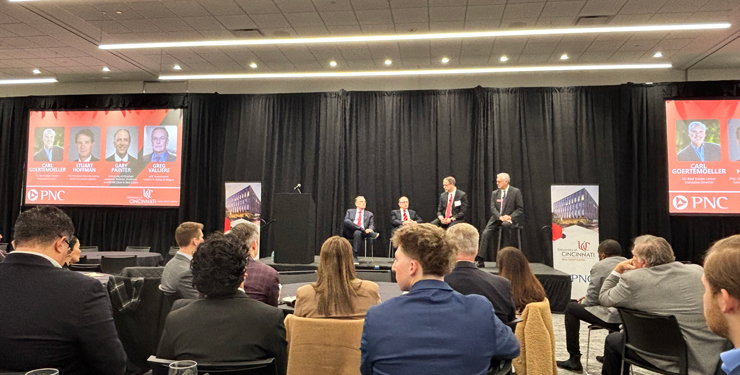
The breakout session, “Industrial Market Trends and Forecasting,” brought the owner perspective into focus. Sonya Verny of Aramark Facilities Management moderated a panel with Marcus Rose of NFI Industries and Allen Teague of Shell Oil Company. Their discussion highlighted how power security, workforce availability, and automation are influencing real estate decisions across different industrial sectors.
A key takeaway was the role of power as an initial site selection filter. Energy security and reliability deserve the same attention as sustainable energy. Workforce analysis also needs to consider how automation will change the skills and staffing required to operate a facility.
Capacity on paper has limited value if it cannot be delivered when production needs it. Connecting those requirements to the operating plan helps owners evaluate a location’s ability to support the business before committing capital.
Workforce and technology must be planned together
Futurologist and author, Magnus Lindkvist’s discussion of demography and technology offered another reason to challenge familiar planning assumptions. He framed automation as a response to workforce shortages as well as a means of improving productivity. This distinction matters when defining a facility’s future needs.
A labor study, an automation strategy, and a building program should inform one another. Equipment choices change the skills employees need, the infrastructure required, and the way people move through and maintain the operation.
For design teams, this means understanding how work will be performed before fixing the layout. Safe access for maintenance, spaces for training, intuitive circulation, and room to modify production systems can all influence how successfully an organization adopts new technology.
Lindkvist also challenged the tendency to approach uncertainty with familiar logic. His observations about ideas crossing industry boundaries carry a practical lesson: owners benefit from perspectives beyond their immediate operation. Bringing operations, technology, workforce, and design expertise into the same conversation can expose assumptions that each group might otherwise carry forward.
The AI discussion added a related caution about how capability can advance rapidly while remaining uneven across tasks. For owners, that supports testing specific applications and validating results as technology is introduced. Facility planning should accommodate that evolution without depending on a single forecast of what AI will deliver or when.
Trust helps teams make better capital decisions
David Horsager, CEO of Trust Edge Leadership Institute, brought the leadership conversation to a direct question—Can I trust you?
His framework connected trust to clarity, compassion, character, competency, commitment, connection, contribution, and consistency. For industrial owners, those qualities have tangible implications for how projects are planned and delivered.
Clarity means people understand the business objective, who owns a decision, and when it must be made. Competency means the right expertise is available when an assumption needs to be tested. Consistency means commitments are tracked and concerns receive follow-through.
These behaviors matter when project teams face difficult tradeoffs. Operations may prioritize continuity, finance may focus on capital exposure, and real estate may be working toward an occupancy deadline. A shared definition of success gives the team a basis for evaluating those competing needs.
This is also where a strategic design partner can contribute early. Helping a client determine where to invest and what to build requires enough trust to question the initial request. An expansion may be the right answer, but it may also be worth testing whether changes to flow, equipment placement, or an existing facility could achieve the desired capacity.
Trust creates room for that examination before the organization commits to a solution.
Employee insight should shape the solution
Sara Ross, Chief Vitality Officer at BrainAmped, emphasized that a leader’s words and tone carry additional weight during uncertainty. People look to leaders for cues about how to respond, and they contribute more when they feel valued, supported, and empowered.
Her emphasis on leading by example, showing empathy, and empowering others translates directly to facility planning. Employees who operate and maintain a process understand constraints that may be difficult to see in a drawing or a performance report.
Inviting that knowledge into the process requires curiosity. What has the team already tried? What else should be considered? What do employees believe the next step should be?
These types of questions can reveal recurring maintenance problems, unnecessary movement, or workarounds that have become accepted practice. They can also help explain why a proposed change may encounter resistance.
For BHDP, connecting people, process, technology, and the built environment starts with understanding these daily experiences. Employee participation helps teams accurately define the problem and develop an effective solution.
Measure resilience through operational performance
The forum’s discussions on resilience challenged the habit of solving only for a defined need at a single point in time. Industrial facilities must continue supporting the business as products, technology, and operating conditions change.
This approach requires owners and design teams to establish performance expectations early and revisit them after occupancy. Depending on the business, useful measures might include production capacity, changeover time, maintenance access, energy performance, or the disruption required to introduce a new process.
The measures should connect to the reason for the investment. If a project is intended to improve production flow, the team should understand the starting conditions and agree on how improvements will be evaluated. If adaptability is a priority, the plan should identify which changes the facility is expected to accommodate.
Operational feedback can then inform future improvements and the next capital decision. This is a central goal of strategic design—maintaining the connection between business strategy, facility investment, and measurable client value throughout the life of the asset.
Turning insight into action with BHDP
Chaunté Lowe, a four-time Olympian, medalist, and cancer survivor, delivered an inspirational message about pursuing excellence through change, providing a fitting challenge for industrial leaders. Her emphasis on courageous action, integrity, and learning from setbacks applies to organizations making consequential decisions under uncertainty.
For industrial leaders, progress begins with a clear understanding of the business need and a willingness to test assumptions with the people closest to the work. It continues through disciplined decisions and an ongoing assessment of what the investment actually delivers.
At BHDP, our strategic design approach connects that work across the facility lifecycle. We help clients clarify the problem before a project is defined, align operational requirements with capital priorities, and translate those decisions into environments that support people and performance. By carrying lessons from operations into future planning, each project can improve the decisions that follow.
The Fall Forum reinforced why that continuity matters. Facilities need to adapt, and the relationships, leadership, and knowledge behind them must support that adaptation.
If you're interested in learning more about our strategic design approach in the industrial market, please fill out the form below.
Author
Content Type
Date
November 02, 2026
Practice
Topic
Innovation
Conferences
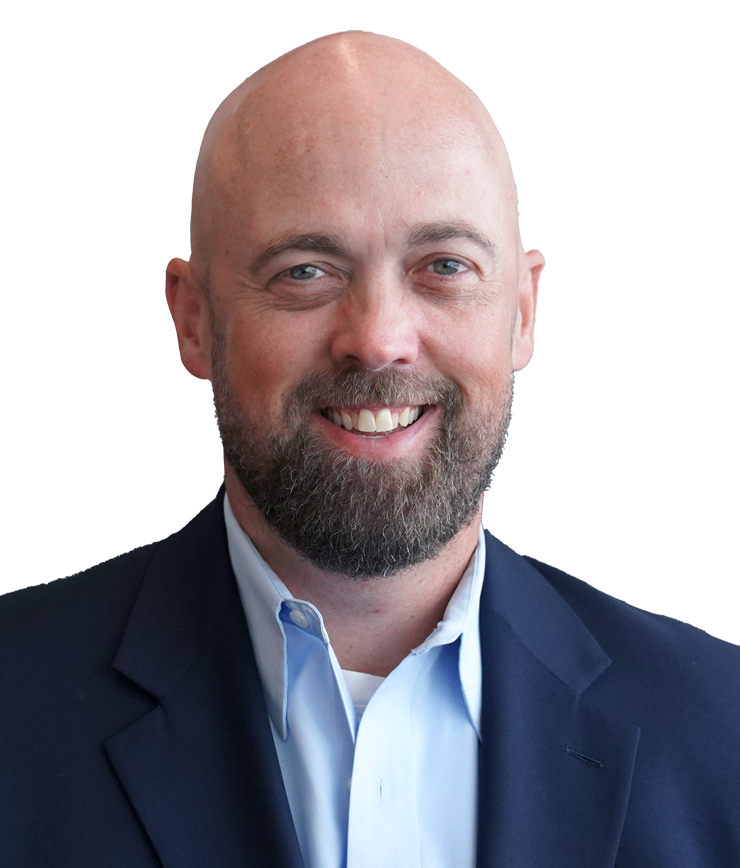
Daniel Lessing, Industrial Market Leader
Daniel Lessing brings over 20 years of experience in plant and environmental engineering, project planning, and construction management to BHDP. As Market Leader for the Industrial team, he leverages his expertise in team management and strategic thinking to lead capital strategy and industrial development initiatives for clients worldwide. Well-versed in every stage of the capital project lifecycle, he is also highly skilled in design and construction. Daniel focuses on driving positive client outcomes through thoughtful planning, integrated design, and disciplined execution.