
Why Manufacturers Are Re-Thinking Master Planning as a Living Business Tool
Manufacturers are making long-term capital investments in one of the least predictable business environments in decades. Automation is evolving faster than facilities can be built. Product lifecycles continue to shorten. Supply chains are being redesigned. Labor markets are changing. Yet many companies still rely on facility master plans made as though the future is fixed.
That creates a fundamental mismatch. A master plan may guide decisions for ten years or more, but many of its assumptions can change within months. Whether it’s shifting production volumes or new equipment and utility needs, when the plan cannot adapt, it stops being useful.
Leaders either make decisions against outdated information or restart the planning process each time conditions change. Both approaches add cost, delay decisions, and increase the risk that today’s investment will constrain tomorrow’s options.
At BHDP, we do not view a master plan as a drawing package. We view it as a business tool that helps leadership in the industrial market (and beyond) make better capital decisions over the next decade.
Why Traditional Master Planning Falls Short
Traditional master planning often begins with a catalyst: a major expansion, a new site, an equipment investment, or a shift in production strategy. The organization gathers data, forecasts demand, tests layouts, and develops a phased plan. Leadership reviews the work, approves it, and then turns its attention to execution.
The process may be thorough, but the output usually captures one point in time. It reflects the products, volumes, technologies, workforce assumptions, and financial priorities that were understood when the plan was created. Once the document is complete, those assumptions are rarely monitored consistently.
Meanwhile, the business keeps moving. Product mix changes. Automation reduces one type of space while increasing another. Utility demand shifts. New customer commitments alter capacity requirements. Capital becomes available in a different sequence than expected. The approved master plan remains static while the operating environment moves around it.
The problem is not that the original plan was poorly developed. The problem is that it was treated as a finished answer instead of a decision framework. By the time the next major investment is considered, leaders may no longer trust the plan—or may not know which assumptions still apply.
The Cost of Planning for One Future
Static plans tend to organize growth around a single projected future: a specific demand curve, production configuration, or expansion sequence. That can create a false sense of certainty. The farther the plan looks ahead, the less likely it is that events will occur in exactly the order anticipated.
When reality diverges from the plan, the consequences accumulate. An expansion blocks a future circulation route. Utilities are sized for the wrong growth scenario. Equipment is placed where it limits the next line. Each decision may make sense individually, but weakens the long-term performance of the site.
Outdated plans also slow decisions. When leaders lack a credible view of current conditions and future options, capital requests become harder to validate and teams spend time recreating information or retesting ideas.
A useful master plan must do more than illustrate an end state. It must show:
- How the business can move from today’s conditions toward several plausible future
- Which decisions need to be made now
- Which choices can remain open until more information is available
Master Planning as a Living Business Tool
A living master plan is designed to evolve with the organization. It establishes a durable strategic framework while allowing operating assumptions, priorities, projects, and timing to change. The goal is not to constantly redraw the plan. The goal is to preserve the logic behind it so leaders can evaluate new information without starting over.
This changes the central question. A static plan asks, “What will the site look like in ten years?” A living plan asks, “What business objectives must the site support, what decisions could limit our options, and how should we respond as conditions change?”
That distinction matters because some decisions—site access, utility corridors, central infrastructure, structural systems, and expansion zones—are difficult and expensive to reverse. Others, including interior configurations, equipment placement, and project sequencing, may need to remain flexible.
A living plan distinguishes between those categories, giving leadership enough direction to make confident near-term investments while protecting the organization’s ability to respond to opportunities that cannot yet be fully defined.
How BHDP Builds Living Master Plans
The ability to adapt begins with how the master plan is created. BHDP’s design process connects business strategy, operational reality, and physical planning through three foundational phases: Understand, Discover, and Concept. Each phase answers a different set of questions, and each creates the basis for the decisions that follow.
Understand: Build the Business Plan and Assess the Need
We begin above the level of buildings and projects. Through a team charter, leadership interviews, visioning, and focused working sessions, we clarify the business objectives, growth strategy, financial drivers, success criteria, and operational constraints that should guide capital investment. We then translate that direction into a needs assessment grounded in historical site, facility, utility, process, and equipment information.
This step often reveals priorities that a drawing alone cannot resolve: adding capacity while limiting near-term capital, automating while preserving flexibility, or maintaining production throughout a multi-year transformation.
By making these drivers explicit, BHDP establishes the criteria against which future options will be evaluated. The master plan becomes connected to business performance—not simply square footage.
Discover: Complete Due Diligence and Define Critical Constraints
Next, we study the operation itself. Site visits, process mapping, adjacency analysis, current- and future-state planning, and direct operational observations help our team understand how materials, people, information, and products move through the site. We compare utility capacity with demand, examine logistics and installation requirements, and identify code, site, operating, and client-standard constraints.
This is where assumptions are tested against reality. Drawings may show available space, but field observations reveal congestion, workarounds, utility limitations, maintenance issues, or employee needs. Conversations across operations, engineering, facilities, finance, human resources, and leadership bring the full system into view.
The result is a shared fact base:
- What is working
- What is constrained
- What must change
- Which operational relationships should be protected as the business evolves
Critical needs and conditional limits are defined, performance criteria are established, and those criteria are ranked before concepts are developed.
Concept: Develop, Evaluate, and Select the Best-Value Option
With the business drivers and operational realities established, BHDP develops and compares multiple scenarios rather than moving immediately to one answer. These may include different expansion paths, infrastructure strategies, site circulation concepts, building configurations, phasing approaches, or ways to preserve flexibility for unknown future needs.
Scenario planning allows leadership to see the tradeoffs behind each direction. One option may minimize immediate cost but create a later operational interruption. Another may require an early infrastructure investment but enable faster growth. A third may protect the most long-term flexibility while accepting a different near-term sequence.
Options are ranked against agreed performance criteria, with pros, cons, scope, order-of-magnitude cost differences, logistics, and key differentiators made visible. The preferred plan is selected for best value against the organization’s priorities, risk tolerance, and capital strategy—not simply the most attractive end-state drawing. The roadmap identifies the base option, added-value choices, and migration or phasing plan.
Because each later phase builds on this foundation, the master plan can evolve rather than restart. When a forecast changes, a project is delayed, or a new opportunity emerges, the team can return to the original decision criteria, update the affected assumptions, and understand how the change influences the broader plan.
What a Living Master Plan Enables
When done right, a living master plan enables a ripple effect of success across both the project at hand and future projects.
Better Capital Decisions
Capital projects are rarely isolated. Adding a production line, relocating a warehouse, or upgrading utilities affects what can happen next. A living master plan makes those interdependencies visible and gives leadership a current framework for comparing investments.
It also helps distinguish enabling investments from stand-alone projects. An infrastructure upgrade may not generate immediate production capacity, for example, but it may be the critical first move that supports several future phases. When that relationship is clear, the organization can evaluate the investment in the context of its broader business value.
Faster Response When Conditions Change
Manufacturers often need to act before every variable is known. When a customer commitment, new product, or acquisition creates pressure for capacity, a current planning framework lets leaders evaluate the opportunity against established constraints and scenarios.
Speed does not come from skipping analysis. It comes from having already completed the right analysis and maintaining it as conditions evolve.
More Flexible, Efficient Growth
Most industrial campuses grow through a series of projects rather than one comprehensive buildout. A living master plan allows each phase to meet an immediate need while advancing—or at least not compromising—the long-term strategy. Expansion zones remain viable. Infrastructure can be extended logically. Material and people flows can improve over time rather than becoming more fragmented with every project.
VEGA Americas: Planning Beyond the Immediate Need
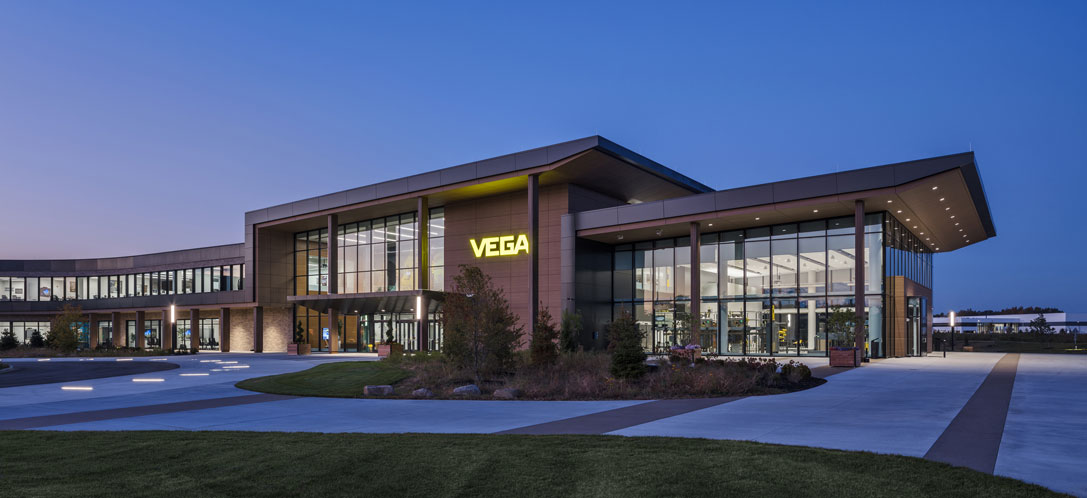
VEGA Americas new headquarters and advanced manufacturing facility located in Mason, OH, designed by BHDP.
VEGA Americas’ new headquarters and advanced manufacturing facility illustrate this approach. The company needed to support current production while planning for the broader evolution of its operations, including research and development, workforce needs, customer experience, and long-term capacity growth that could not be fully specified at the outset.
BHDP began by establishing the operational drivers that would guide subsequent decisions:
- How work needed to flow
- Which adjacencies mattered
- How production and support functions should relate
- Where flexibility would be most valuable.
Those priorities became a stable foundation even as individual requirements continued to develop.
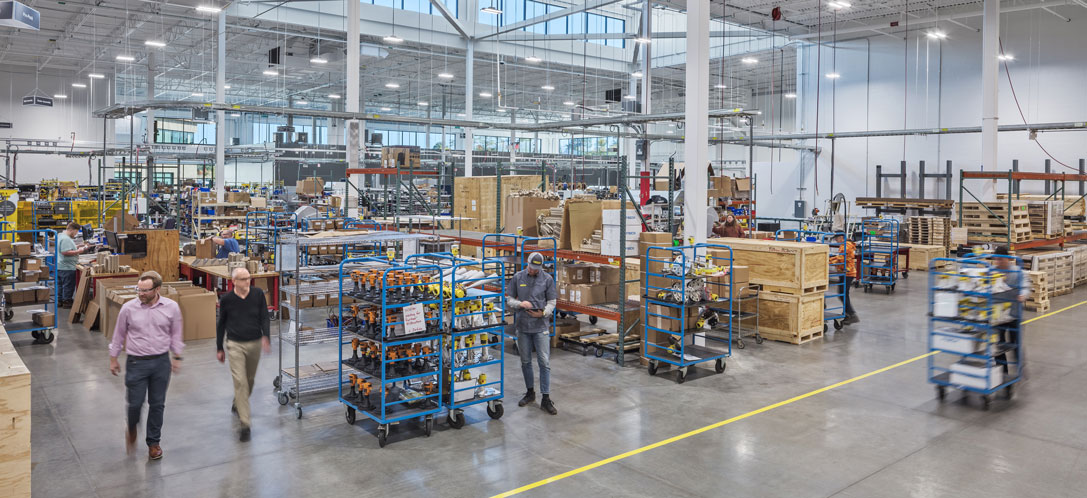
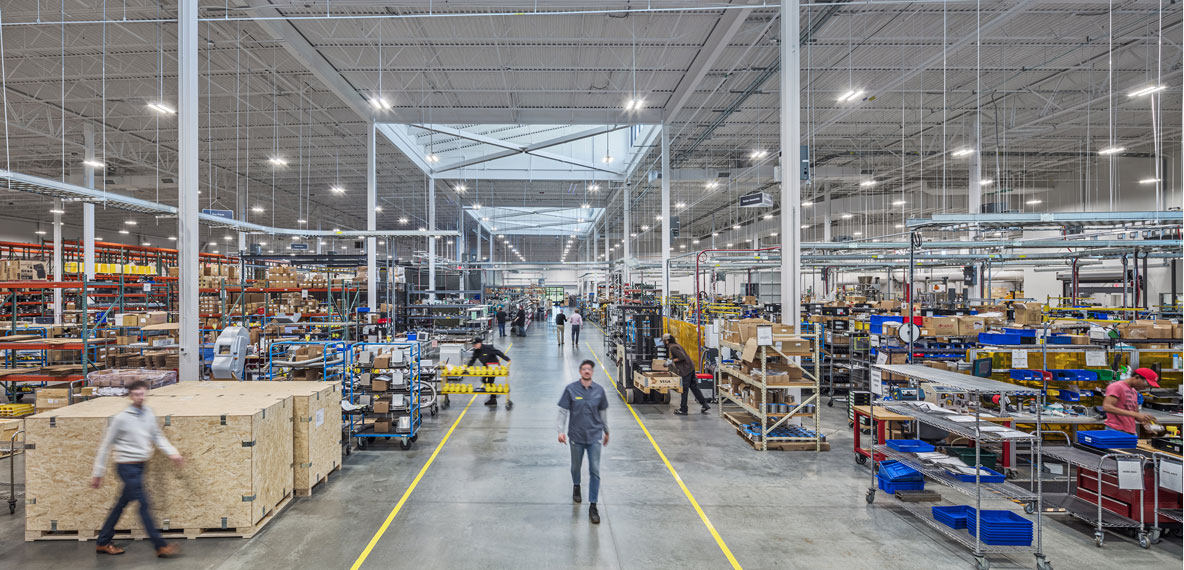
VEGA Americas’ headquarters in Mason, OH, includes an advanced manufacturing facility that houses components and parts, production and assembly, and finished product shipping operations.
The resulting facility met VEGA Americas’ immediate needs while creating a framework for growth. Because the plan was organized around durable business and operational objectives rather than a rigid forecast, evolving requirements could be incorporated without losing the overall direction.
The lesson is larger than a single project. When an organization defines what matters most before locking in what the future must look like, it creates room to adapt without sacrificing strategic alignment.
You can read more about the project in the VEGA Americas case study.
Keeping the Plan Alive
A living master plan requires discipline after the initial work is complete. It should be reviewed alongside annual capital planning, major equipment decisions, product introductions, acquisitions, or changes in demand. The cadence should match the pace of the business.
The review does not need to repeat the full master planning process. Instead, the team revisits the original drivers and asks what has changed:
- Are the growth assumptions still reasonable?
- Have automation or process decisions altered space and utility requirements?
- Does the phasing sequence still support the capital plan?
- Have any projects created new constraints or opportunities?
Updates can then be focused where they matter. The current-state information, project priorities, scenarios, and implementation roadmap are refined while the durable strategic framework remains intact. This is what allows the plan to stay relevant without becoming a continuous planning exercise.
Is Your Master Plan Still Guiding Decisions?
Before the next capital investment, leadership teams should ask a few direct questions:
- When was the plan last updated, and what has changed in the business or operation since then?
- Does it reflect current products, volumes, equipment, workforce needs, and infrastructure constraints?
- Can it accommodate more than one growth scenario, or does it depend on a single forecast?
- Does it show which near-term decisions could protect—or eliminate—future options?
- Are leaders actively using the plan to prioritize capital, or working around it because they no longer trust it
If the plan has drifted from operational reality, the answer is not necessarily to discard it. The stronger response is to revisit the business drivers, update the facts, and restore the connection between the organization’s strategy and its facilities.
Planning That Evolves With the Business
Manufacturers cannot predict every product, technology, workforce shift, or market condition they will encounter over the next decade. They can, however, create a planning framework that helps them respond intelligently.
A living master plan is not a more complicated document. It is a more useful way to make decisions: grounded in business objectives, informed by how operations actually work, tested across multiple scenarios, and structured for refinement as conditions change.
The goal is not to predict the future. It is to make today’s investments without unnecessarily limiting tomorrow’s choices.
Ready to Revisit Your Master Plan?
If your current master plan no longer reflects where your operations are heading, BHDP works with manufacturing organizations to build planning frameworks that evolve alongside the business—grounded in operational reality and structured to support confident, long-term capital decisions.
Reach out to BHDP to start the conversation today for successful master planning tomorrow—and beyond.
Author

Daniel Lessing, Industrial Market Leader
Daniel Lessing brings over 20 years of experience in plant and environmental engineering, project planning, and construction management to BHDP. As Market Leader for the Industrial team, he leverages his expertise in team management and strategic thinking to lead capital strategy and industrial development initiatives for clients worldwide. Well-versed in every stage of the capital project lifecycle, he is also highly skilled in design and construction. Daniel focuses on driving positive client outcomes through thoughtful planning, integrated design, and disciplined execution.