
Hospitality as the Operating System of Workplace Experience
In recent years, workplace hospitality has become a more prominent part of conversations about workplace design, amenities, employee experience, and organizational culture. Much of that conversation has focused on visible improvements such as concierge services, wellness environments, food and beverage programs, residential cues, and spaces that feel warmer and more human. While those shifts matter, the more strategic opportunity lies beneath this visible layer. The central question is not simply what hospitality-inspired features an organization should add, but what experience the workplace should create and what behaviors that experience should enable.
At BHDP, we think of hospitality as the operating system of workplace experience. If we view the workplace as infrastructure for performance, hospitality shapes the experience of using that infrastructure. It helps organizations design the conditions that support connection, focus, learning, belonging, and shared understanding.
That shift changes the design conversation. Instead of only considering, “What spaces should we provide?”, we shift focus to answering, “How should the workplace experience help people work better together?”
Workplace Hardware Provides Capability
The physical workplace is the hardware layer. It includes the spatial, technical, and environmental systems that enable work. These include:
- Spatial layout
- Meeting and focus rooms
- Technology infrastructure
- Lighting
- Acoustics
- Environmental systems
- Furniture
- Equipment
These elements are essential to both the work experience and the work itself. Poor acoustic conditions can undermine concentration. Inadequate meeting technology can make collaboration frustrating. Unclear wayfinding can create friction before work even begins. Even well-designed spaces and systems do not automatically determine how people use the workplace or how they feel while using it.
The physical workplace provides capability. Hospitality shapes how that capability is experienced.
Hospitality Translates Capability into Experience
Hospitality is the experience layer that determines whether workplace capability feels intuitive, supportive, meaningful, and easy to use. It shapes how people:
- Arrive
- Orient themselves
- Find resources
- Interact with others
- Receive support
- Recover
- Focus
- Participate in the life of the organization
A workplace with strong physical assets can still underperform when the experience of using those assets feels confusing, unsupported, or disconnected from culture. Hospitality helps translate physical infrastructure into human experience by giving the workplace a more coherent rhythm of welcome, meaning, comfort, activation, and service.
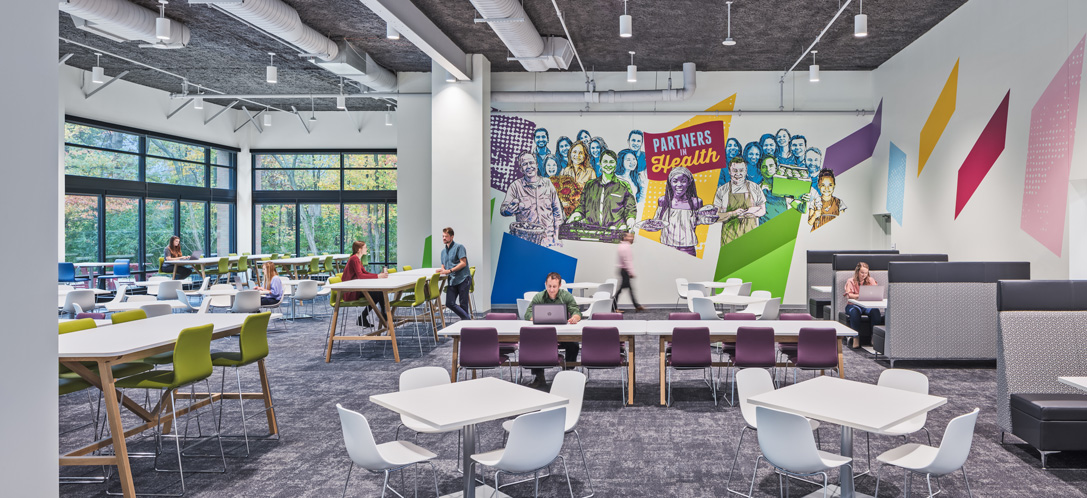
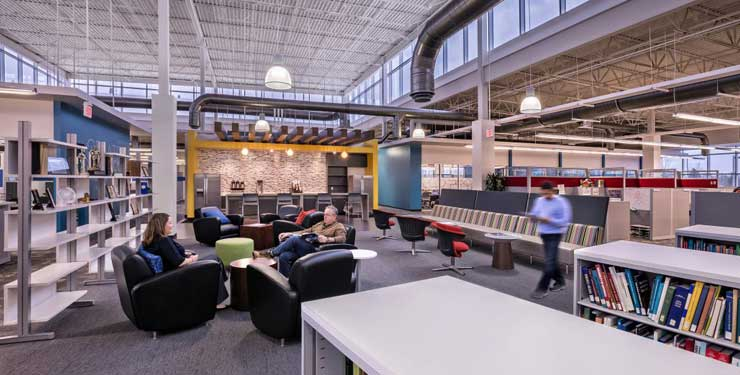
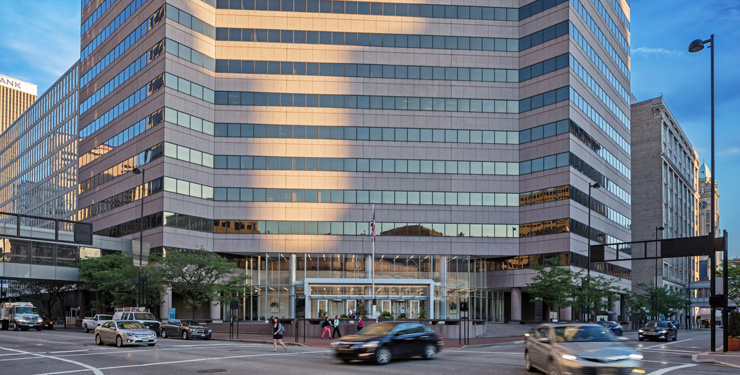
The Ensemble Health Partners global headquarters in Blue Ash, Ohio
Relationships Are the Value Driver
The workplace creates its greatest value when it strengthens the human dynamics that are harder to replicate elsewhere: connection, learning, shared understanding, mentorship, trust, and culture. Studies across retention, engagement, and in-person work point in the same direction.
An MIT Sloan article shares that toxic culture is more than 10 times as predictive of employee attrition as compensation. Gallup reports that only about one in five employees globally is engaged at work. Microsoft’s Work Trend Index found that 84% of employees would be motivated to go into the office by the promise of socializing with coworkers, and 73% would go more frequently if they knew their direct team members would be there. Together, these findings suggest that workplace value is shaped less by the building as an object and more by the relationships, behaviors, and shared experiences the environment helps enable.
Put simply: People draw people. Culture retains people. Space supports people.
The design of physical environments cannot solve leadership or cultural problems on its own, but it can reinforce or undermine cultural intent. The workplace either supports healthy dynamics or amplifies unhealthy ones.
That is why hospitality matters. It provides a way to intentionally design for the human experience of work, including how people connect, focus, collaborate, recover, and participate in organizational culture.
BHDP’s Workplace Hospitality Framework
At BHDP, we’ve organized workplace hospitality around five dimensions: Welcome, Meaning, Comfort, Activation, and Service. Each dimension translates hospitality principles into workplace experiences that support performance outcomes.
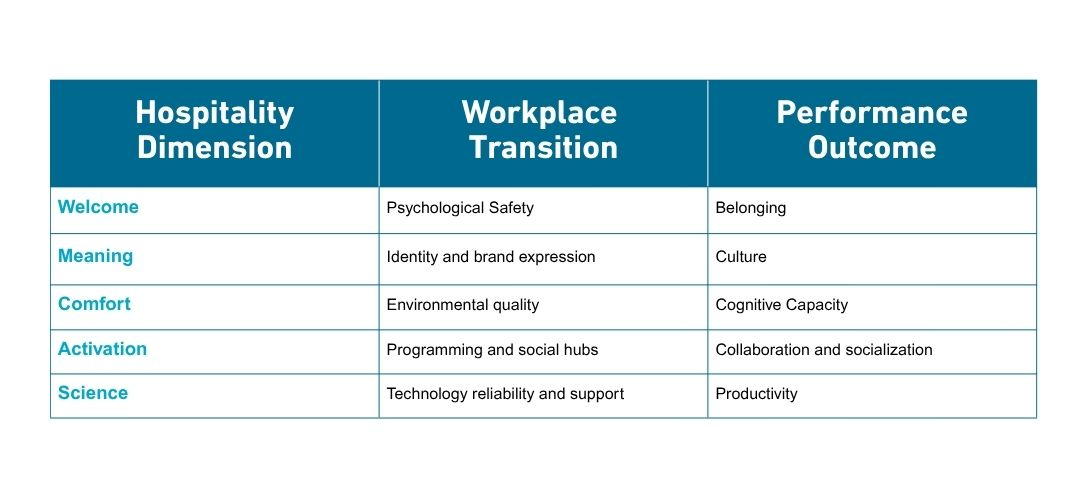
These dimensions are not isolated categories; they work together as part of an experience system.
- Welcome shapes how people feel when they enter the workplace. Arrival sequences, wayfinding, visibility, and greeting moments reduce uncertainty and establish emotional tone.
- Meaning connects people to identity, purpose, and culture. Storytelling, brand expression, local context, and visible organizational values help the workplace feel like a shared environment rather than a generic container.
- Comfort supports cognitive and physiological performance. Lighting, acoustics, thermal quality, ergonomics, biophilia, and spatial variety influence focus, stamina, and well-being.
- Activation creates intentional opportunities for interaction. Social hubs, programming, rituals, and events help transform space into community infrastructure.
- Service reduces friction. Reliable technology, responsive support, intuitive booking systems, hospitality-trained staff, and workplace concierge services help people focus on the work that matters.
Together, these dimensions shape how people feel, interact, focus, connect, and perform.
From Amenity Thinking to Experience Thinking
The workplace is no longer the default location for work it once was. It now serves a more specific purpose in a broader ecosystem of work settings. Its value is not that it provides a desk. Instead, its unique value lies in creating conditions for connection, learning, focus, shared understanding, cultural reinforcement, and collective performance. Many organizations continue to conflate amenities with experience.
Consider the difference:
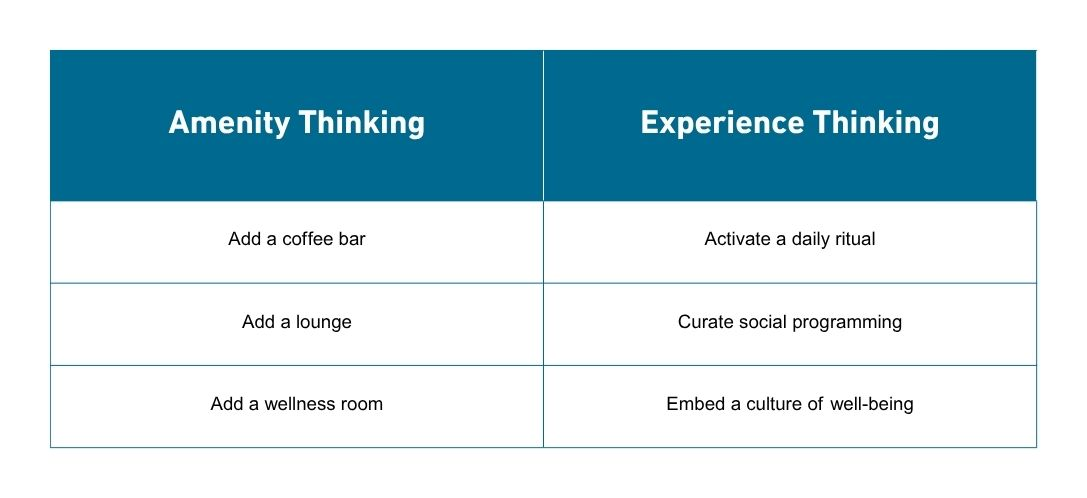
A coffee bar creates value when it becomes part of a social ritual. A lounge supports collaboration when it enables interaction. A wellness room contributes to well-being when it supports recovery and restoration during the workday. The object itself is only the starting point; the experience is what ultimately creates value.
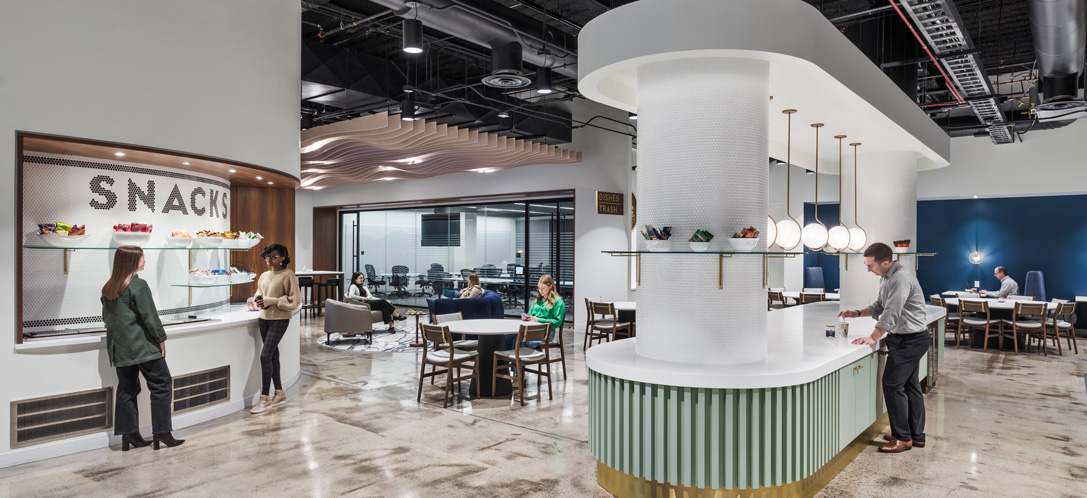
The P&G Gym in Cincinnati, Ohio, complete with amenities carefully designed to spur connection and valuable workplace experiences.
The workplace becomes more valuable when spaces and amenities are connected to the behaviors they are intended to support. This changes conversations with clients from “What amenities should we add?” to “What experiences do we need to create, and what behaviors should those experiences support?” That is the difference between amenity thinking and hospitality thinking.
Operationalizing Hospitality
Once hospitality moves beyond amenities, it begins to operate across multiple workplace domains. These domains are where the hospitality framework becomes visible in daily workplace experience.
Examples include:
- Arrival experiences: concierge-style reception, intuitive wayfinding, digital check-in, hospitality-trained greeters, and arrival lounges.
- Food and beverage: social cafés, coffee rituals, community dining, chef-driven programming, and hospitality pantry concepts.
- Learning and innovation: learning cafés, immersive onboarding spaces, prototyping studios, internal forums, and visible innovation environments.
- Wellness ecosystems: restorative spaces, movement-integrated environments, circadian lighting, acoustic wellness, decompression zones, and outdoor work settings.
- Programming and events: hosted gatherings, learning salons, social rituals, seasonal activations, and team anchor-day experiences.
- Workplace services: integrated technology support, frictionless room booking, responsive service requests, AI-enabled assistance, and concierge-style workplace support.
- Cultural storytelling: mission-driven graphics, organizational history, employee artifacts, local cultural integration, and brand immersion.
Food and beverage is a useful example because it often touches multiple dimensions at once. A coffee ritual can activate social interaction. A healthy food offering can support comfort and well-being. Meeting catering can function as service. A culinary experience tied to organizational identity can reinforce meaning. Hospitality is powerful precisely because it works across the system, connecting the above-mentioned dimensions of Welcome, Meaning, Comfort, Activation, and Service into a more coherent workplace experience.
Leading organizations are shifting from workplace amenities to orchestrated experience ecosystems. Traditional workplace models often focus on space efficiency, assigned workstations, and amenities as objects. Hospitality-led models focus on experience quality, social activation, service integration, cultural meaning, and workplace behaviors.
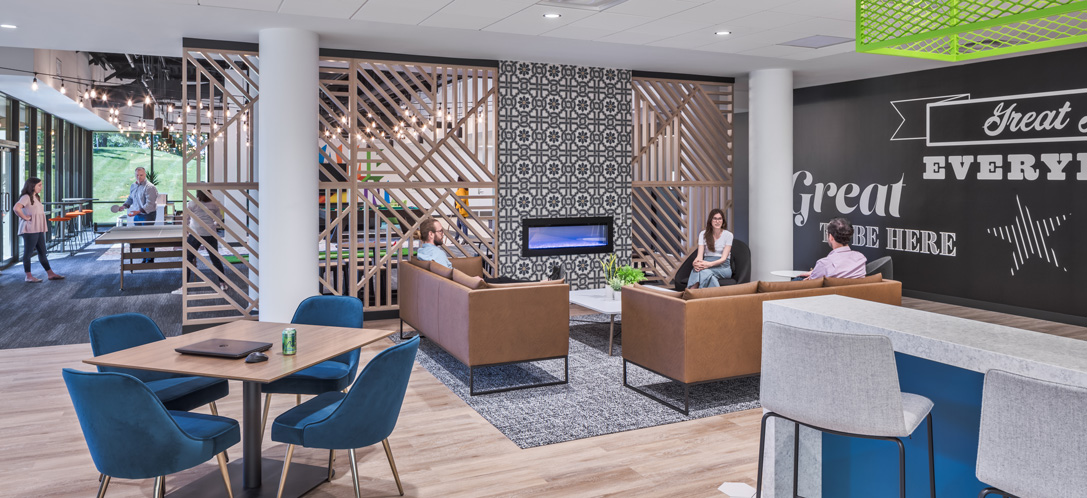
Quantum Health’s corporate headquarters in Columbus, Ohio.
What Success Sounds Like
The success of workplace hospitality should not be measured only by utilization or attendance. Those metrics matter, but they do not tell the whole story. A workplace can be occupied and still fail experientially. It can be busy and still feel unsupported, disconnected, or transactional.
A more meaningful signal is when employees begin to talk about the workplace differently. Such a shift in language moves from “I have to go in today,” to “I get to go in today.” That shift reflects more than preference; it signals a change in the perceived value of the workplace. The environment becomes more than a place people are required to occupy. It becomes a place where people expect something meaningful to happen.
Hospitality as Operating System
When hospitality is designed with intention, it becomes the operating system for workplace experience, reducing friction, shaping interaction, and supporting the conditions for connection, learning, focus, and shared purpose. It helps organizations move beyond amenity checklists and toward environments that support connection, learning, focus, culture, and performance.
By translating physical infrastructure into a more coherent system of welcome, meaning, comfort, activation, and service, hospitality turns the workplace from a collection of spaces into a system of experiences. In a world where time together matters more than ever, that experience deserves to be designed with purpose
BHDP Can Help Update Your Hospitality Operating System
The value of workplace lies in what happens when people are together. Hospitality shapes the experience of that time.
BHDP is a leading force in effective and holistic Workplace design. From legacy business headquarters to boutique private offices, our team of experts is well-versed in the nuances of designing the spaces where we work.
Fill out the form to see how BHDP can help you update your workplace’s hospitality operating system.
Author
Content Type
Date
June 25, 2026
Market
Topic
Workplace Strategy
Wellness

Dr. Justin Ferguson, Director of Applied Research
With three decades of researching, teaching, and practicing community-engaged and organizational design and planning, Dr. Justin Ferguson brings both immense knowledge and enthusiasm to creating strategic and transformative environments. As Director of Applied Research, Justin seeks to uncover the challenges clients face with their organizational spaces, works with design teams to develop predictive design decision-making, and ultimately measures the efficacy of BHDP’s work. His extensive portfolio spans various markets across the U.S., including collaborations with major clients like the GSA and Fifth Third Bank, making him a unique asset to BHDP.